Dogwood Investment Advisors

630 Dundee Road, Suite 110

Northbrook, IL 60062

847.220.4044

www.dogwood-investments.com

December 2025
Market Update
(all values as of 11.28.2025)

Stock Indices:

Dow Jones 47,716
S&P 500 6,849
Nasdaq 23,365

Bond Sector Yields:

2 Yr Treasury 3.47%
10 Yr Treasury 4.02%
10 Yr Municipal 2.74%
High Yield 6.58%

YTD Market Returns:

Dow Jones 12.16%
S&P 500 16.45%
Nasdaq 21.00%
MSCI-EAFE 24.26%
MSCI-Europe 27.07%
MSCI-Emg Asia 26.34%
MSCI-Emg Mkt 27.10%
 
US Agg Bond 7.46%
US Corp Bond 7.99%
US Gov’t Bond 7.17%

Commodity Prices:

Gold 4,253
Silver 57.20
Oil (WTI) 59.53

Currencies:

Dollar / Euro 1.15
Dollar / Pound 1.32
Yen / Dollar 156.21
Canadian /Dollar 0.71
 

Macro Overview

A lack of government data detailing employment and inflation metrics continued to be of concern in November, as markets relied more on private sector entities to replace absent government data.

The Labor Department released a long-delayed government employment report, which showed that job growth picked up in September while the unemployment rate edged higher. The data suggested the labor market showed signs of stabilizing before the government shutdown which began on October 1st. The delayed employment data came out a day after the Federal Reserve’s last policy meeting revealing a divided committee on whether to cut interest rates again.

The Bureau of Labor Statistics, part of the U.S. Department of Labor, canceled its October consumer price index report because it was unable to retroactively obtain some data that wasn’t collected during the government shutdown. This marks the first time the agency has forgone publishing a monthly CPI report, according to decades of archived news releases back to 1994. While past shutdowns delayed publication of economic data, this was the first instance that the BLS wasn’t able to produce a major report.

Crypto currencies suffered a sizable pullback in November as confidence in digital currencies subsided. The most recognized and most widely traded digital currency is Bitcoin, which has declined nearly 30% from its 2025 high as of the end of October, lagging behind other investment categories from technology stocks to Treasury bonds.

The extreme delay in employment data from the Department of Labor has elevated reliance on private data sources from some of the nation’s largest payroll companies. A report released by payroll processor ADP divulged that U.S. companies shed payrolls in November by the most since early 2023, adding to concerns about a more pronounced weakening in the labor market.

China’s manufacturing activity surprisingly contracted in November for the first time in four months as new orders nearly stalled, adding to concerns about the country’s deepening economic slowdown. As the world’s largest exporter, China’s manufacturing activity is an indicator of global demand, with China accounting for $3.5 trillion of global exports.

Mass layoffs by U.S. companies surged in October to among the highest levels on record, according to data released by the Federal Reserve Bank of Cleveland. Approximately 39,000 Americans were given advance notice as required under the Worker Adjustment and Retraining Notification Act in October.

Sentiment surrounding the amount and frequency of additional Federal Reserve rate reductions has soured as various Fed officials have communicated a preference of fewer rate reductions over a longer period of time. Elevated home prices and stubborn mortgage rates continue to hinder the housing market throughout the country.

Sources: Labor Dept., Federal Reserve, Treasury Dept., BLS
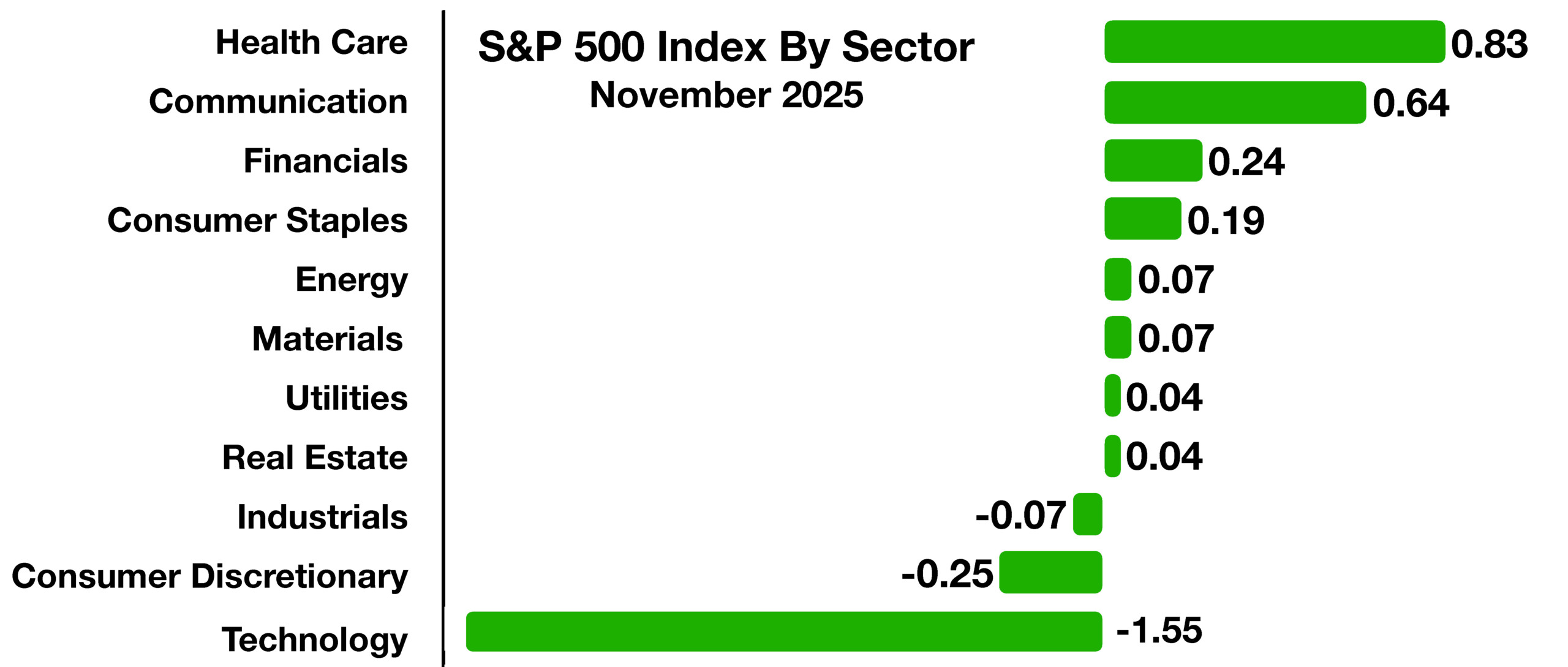
 
the Health care sector added 0.83% to the S&P 500 Index In November

Equity Markets Demonstrate A Rotation In November – Equity Overview

Markets became increasingly volatile in November as big tech companies projected massive capital expenditures which are increasingly reliant on issuing large amounts of debt for funding such projects. Many analysts are struggling as to how long it will take for the massive capital infusions to pay off.

The healthcare sector contributed to the S&P 500 Index’s appreciation in November, while the technology sector dragged on the index for the month. Healthcare added 0.83%, while technology contributed to a 1.55% loss for the index. Such dynamics are recognized by analysts as what is known as a sector rotation, which could be construed as a move to more consistent, and less volatile industries and companies.

Other clues of a rotation include the industrial and consumer discretionary sectors contributing losses to the index in November, indicative of a rotation or move away from economic sensitive sectors. (Source: S&P, Bloomberg)

Rates Aren’t Falling As Quickly As Hoped – Fixed Income Overview

Bond market performance in 2025 is expected to be the best since 2020, as falling rates and rising demand have generated a rally in nearly all bond sectors.

Treasury investors have been looking at metrics like those from one of the nation’s largest payroll processors closely, in the absence of official government data. Private data has begun to influence bond markets as reliance on government data dwindled over the past two months.

Analysts believe that the Fed will slow its pace of interest rate reductions and lengthen the time to reduce rates, dismissing expectations of more rapid rate cuts. The burden on consumer loans and small company debt payments may worsen already strained conditions. (Sources: Treasury Dept., Federal Reserve)

Year End Gifts – Tax Planning

An individual can give up to $19,000 in money or property to any number of individuals in 2025 without having to file a gift tax return or use any of the lifetime exemption. The limit applies to each person that receives a gift, with married couples able to combine their gift total to $38,000 to any individual in 2025 without needing to file a gift tax return. The recipient never pays a gift tax and the responsibility falls on the donor. Most people never have to pay gift tax due to the large lifetime exemption amount, currently at $13.99 million for individuals, and $27.98 million for married couples. The IRS requires that form 709 be filed for any gifts made over the annual exclusion amount of $19,000 in order to track how much of the lifetime exemption may have been used. (Source: IRS)


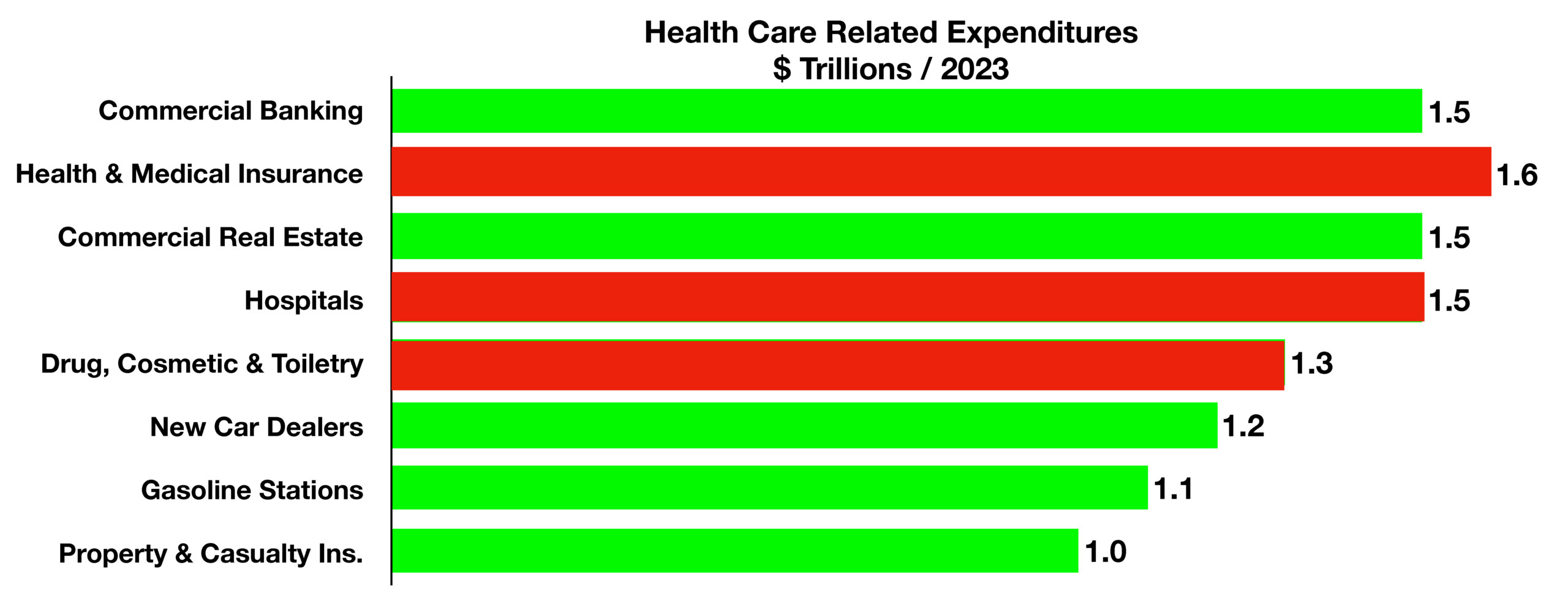
national health expenditures reached about $4.9 trillion in 2023

How The Health Care Industry Reinforces The U.S. Economy – Sector Analysis

The U.S. health care industry supports the economy by making up a large share of national spending, creating millions of jobs, and boosting productivity by improving people’s health and ability to work. It is both a major economic sector in its own right and a foundation for growth in other industries.

Health care is one of the largest sectors in the U.S. economy, with national health expenditures reaching about $4.9 trillion in 2023, or roughly 18 percent of gross domestic product (GDP). This scale means that decisions about health care prices, coverage, and efficiency have direct effects on overall economic growth and government budgets.

A substantial share of the U.S. workforce is employed in health care, with approximately 11 percent of American workers in positions with hospitals, clinics, and long‑term care. These jobs generate large payrolls and support local economies through hospital spending, supplier contracts, and employee consumption in surrounding communities.

Health care spending supports economic growth by improving population health, which in turn raises labor productivity and reduces absenteeism and disability. Better health and broader insurance coverage can increase labor supply and make it easier for people to change jobs, supporting more efficient labor markets and higher long‑run GDP.

As a major component of federal and state budgets, health care accounts for roughly a quarter of government spending through programs such as Medicare and Medicaid. While rapid cost growth creates fiscal pressures, these programs also transfer income to providers and communities, supporting employment and stabilizing demand during economic downturns.

The U.S. health industry drives innovation in pharmaceuticals, medical devices, and health technologies, which can create high‑value exports and spin‑off industries. Economists believe that an improving health care industry could further increase U.S. GDP by adding trillions of dollars in economic value over the coming decades. (Sources: Federal Reserve, Dept. of Labor)

Gold Is Off Its Highs – Commodity Overview

Historically, gold has been one of the most sought after commodities to hedge against inflation, and now it is taking on new characteristics. The onslaught of gold Exchange Traded Funds (ETFs) and recently introduced cryptocurrency funds backed by gold have elevated the demand for the commodity. Some analysts and economists have become more skeptical of some of these newly introduced gold products, especially during the price surge of this past year.

The gold market remains highly active, with volatility driven by ongoing macroeconomic events, central bank policies, and geopolitical risks. Gold retracted from its highs in October, after reaching $4,359 per ounce on October 20th, ending the month at $4,013 on October 31st. (Sources: Federal Reserve FRED)


the average 30-year mortgage hit a high of 7.24% in November 2023

Concerns Heading Into 2026 – Economic Dynamics

Uncertainty surrounding numerous dynamics have evolved throughout the year, shedding light on what consumers and the markets are truly worried about.

Tariffs – The future of the imposed tariffs from earlier in the year are in the hands of the Supreme Court, which is expected to make a ruling at any time, but at the latest by the end of its current term which concludes in late June 2026.

Fed Rate Cuts – Internal indecision among Fed officials has prompted analysts to expect the Fed to slow its pace of reducing interest rates as well as lengthening the process.

Inflation – Consumers are expecting lingering elevated prices for goods and services to continue into 2026, affecting spending and discretionary purchases.

Jobs & Income – Weakness in the employment market is translating into layoffs and less pay increases, adding anxiety to an already stressed consumer.

Interest on Debt – Credit card, mortgage, and auto loan rates are hindering additional spending by consumers already saddled with high monthly payments.

Geopolitical Tensions & Global Conflicts – Contributes to a general sense of uncertainty that reinforces worries about energy prices, supply chains, and future economic shocks.

As a result, consumers are prioritizing essentials, seeking value and promotions, and delaying or reducing spending on discretionary items such as dining out, furniture, and electronics. (Sources: Reuters, Bloomberg)

Housing Market Is Among The Least Affordable In U.S. History – Housing Market
 
Measured by the Housing Affordability Index, the affordability of homes has been steadily eroding since early 2021. Factors affecting affordability include home prices, mortgage rates, and household incomes. With historic inflation outpacing income growth, home buyers in the U.S. have been unable to keep up with rising prices and mortgage rates.

When the Fed increases interest rates to combat inflation, mortgage rates are similarly affected. The average 30-year mortgage rate rose to a high of 7.24% in November 2023, the highest since 2001. This is a significant difference to the lows reached in 2021, when the average 30-year mortgage fell to 2.65%, the lowest in U.S. history. Higher mortgage rates create a less affordable environment for home buyers and harms potential buyers’ abilities to acquire property.

Sources: National Association of Realtors, Federal Reserve Bank of St. Louis, Freddie Mac