Michael McCormick

5 West Mendenhall, Ste 202 | Bozeman, MT 59715

406.920.1682  mike@mccormickfinancialadvisors.com

Sustainable Income Planning | Investments | Retirement

December 2025
Market Update
(all values as of 11.28.2025)

Stock Indices:

Dow Jones 47,716
S&P 500 6,849
Nasdaq 23,365

Bond Sector Yields:

2 Yr Treasury 3.47%
10 Yr Treasury 4.02%
10 Yr Municipal 2.74%
High Yield 6.58%

YTD Market Returns:

Dow Jones 12.16%
S&P 500 16.45%
Nasdaq 21.00%
MSCI-EAFE 24.26%
MSCI-Europe 27.07%
MSCI-Emg Asia 26.34%
MSCI-Emg Mkt 27.10%
 
US Agg Bond 7.46%
US Corp Bond 7.99%
US Gov’t Bond 7.17%

Commodity Prices:

Gold 4,253
Silver 57.20
Oil (WTI) 59.53

Currencies:

Dollar / Euro 1.15
Dollar / Pound 1.32
Yen / Dollar 156.21
Canadian /Dollar 0.71
 
‘Hindsight, the ability to explain the past, gives us the illusion that the world is understandible, that things make sense, even when they don’t.  That’s a big deal in producing mistakes.’ Behavioral Economist Daniel Kahneman

Dear Friends,

For the past 10 years the stock market has been on a tear.  Most portfolios are up, up and up.  Big tech spending on AI research is a big part of recent gains, accounting for about $1.5 Trillion in 2025 according to Gemini.  Without this spend, the economy could have looked pretty stagnant this year.  This money doesn’t just stay in tech bro pockets, instead it permeates throughout the economy as power centers are upgraded, financial products are born, bonuses are paid and spent on Bozeman vacations, and so on.  Technology is everywhere, and therefore so is its excess and impacts.

In this issue, focus is given to a few safe haven investments that may sacrifice some upside for downside protection.  The two main principals of defensive investing are: diversification and rebalancing your risk.  A third, often forgotten tenant is even more important: moderation is always the rule.  You don’t know the future and neither do I.  The truth is that no one predicted 2025 correctly and no one knows what 2026 will look like (currently pretty good they say!).

But while the market will do unpredictable things, we can control our behavior.  Fear of loss is almost 2x greater than the satisfaction of making more money and that can lead to missing out, or worse.  We have always kept heavy allocations to the boring stocks, the ones that don’t fly as high but quietly chug along.  And don’t forget dividends!  We love dividend income in retirement and you should too!

Feeling grateful for family, friends and business relationships.

Concerns Heading Into 2026 – Same same

 
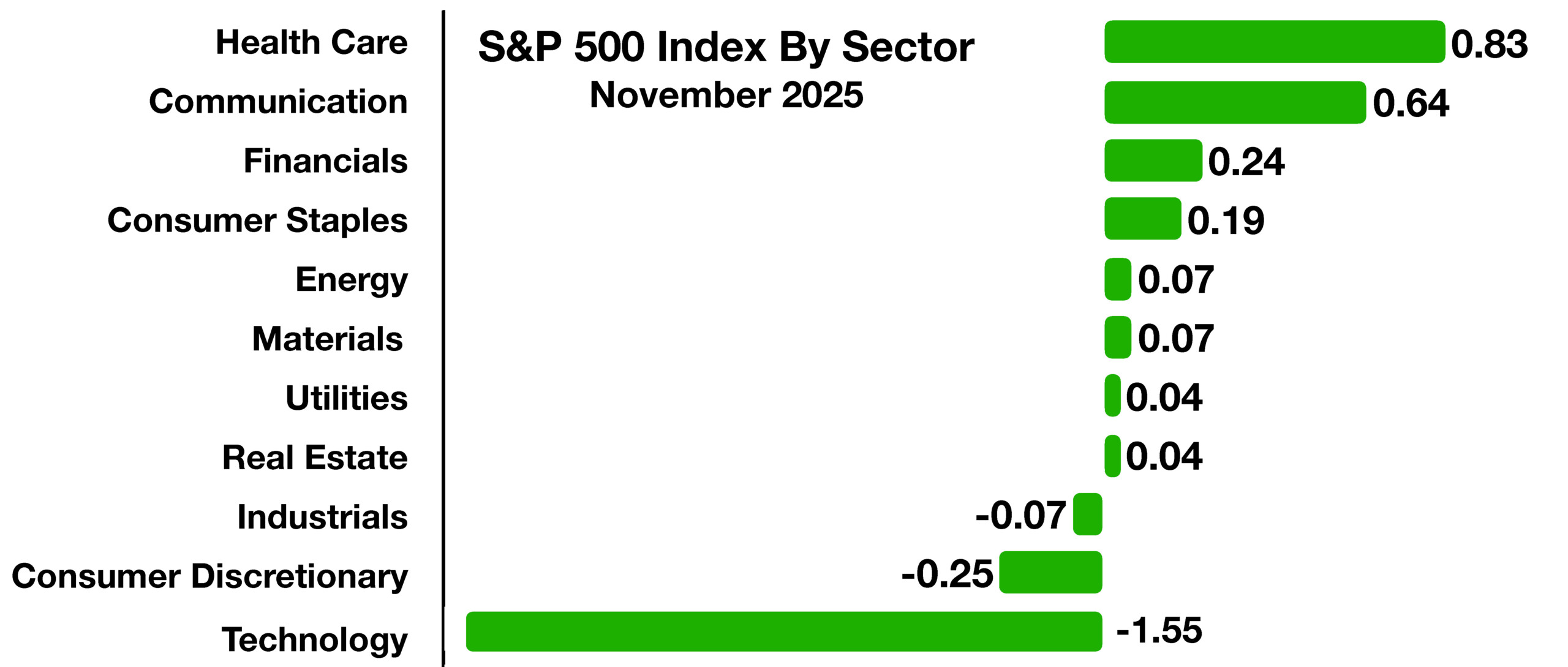
the Health care sector added 0.83% to the S&P 500 Index In November

Equity Markets Demonstrate A Rotation In November – Equity Overview

Markets became increasingly volatile in November as big tech companies projected massive capital expenditures which are increasingly reliant on issuing large amounts of debt for funding such projects. Many analysts are struggling as to how long it will take for the massive capital infusions to pay off.

The healthcare sector contributed to the S&P 500 Index’s appreciation in November, while the technology sector dragged on the index for the month. Healthcare added 0.83%, while technology contributed to a 1.55% loss for the index. Such dynamics are recognized by analysts as what is known as a sector rotation, which could be construed as a move to more consistent, and less volatile industries and companies.

Other clues of a rotation include the industrial and consumer discretionary sectors contributing losses to the index in November, indicative of a rotation or move away from economic sensitive sectors. (Source: S&P, Bloomberg)

Rates Aren’t Falling As Quickly As Hoped – Fixed Income Overview

Bond market performance in 2025 is expected to be the best since 2020, as falling rates and rising demand have generated a rally in nearly all bond sectors.

Treasury investors have been looking at metrics like those from one of the nation’s largest payroll processors closely, in the absence of official government data. Private data has begun to influence bond markets as reliance on government data dwindled over the past two months.

Analysts believe that the Fed will slow its pace of interest rate reductions and lengthen the time to reduce rates, dismissing expectations of more rapid rate cuts. The burden on consumer loans and small company debt payments may worsen already strained conditions. (Sources: Treasury Dept., Federal Reserve)

Year End Gifts – Tax Planning

An individual can give up to $19,000 in money or property to any number of individuals in 2025 without having to file a gift tax return or use any of the lifetime exemption. The limit applies to each person that receives a gift, with married couples able to combine their gift total to $38,000 to any individual in 2025 without needing to file a gift tax return. The recipient never pays a gift tax and the responsibility falls on the donor. Most people never have to pay gift tax due to the large lifetime exemption amount, currently at $13.99 million for individuals, and $27.98 million for married couples. The IRS requires that form 709 be filed for any gifts made over the annual exclusion amount of $19,000 in order to track how much of the lifetime exemption may have been used. (Source: IRS)


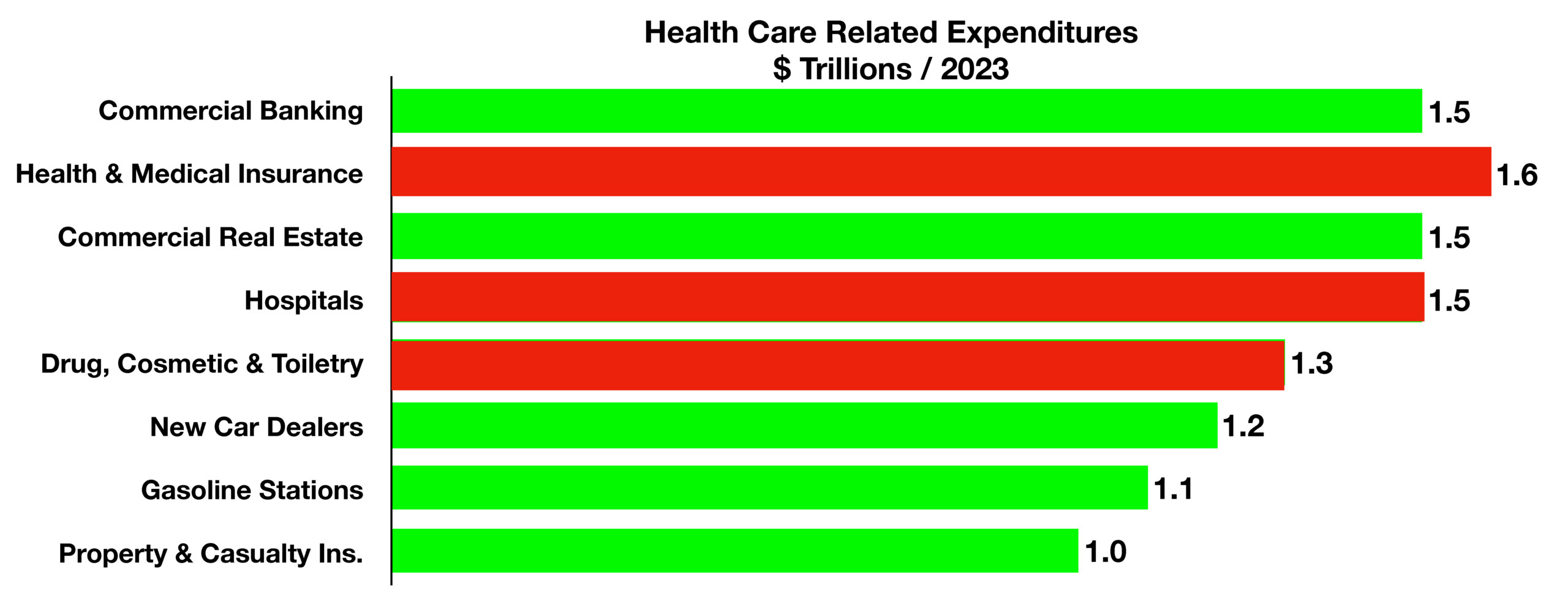
national health expenditures reached about $4.9 trillion in 2023

How The Health Care Industry Reinforces The U.S. Economy – Sector Analysis

The U.S. health care industry supports the economy by making up a large share of national spending, creating millions of jobs, and boosting productivity by improving people’s health and ability to work. It is both a major economic sector in its own right and a foundation for growth in other industries.

Health care is one of the largest sectors in the U.S. economy, with national health expenditures reaching about $4.9 trillion in 2023, or roughly 18 percent of gross domestic product (GDP). This scale means that decisions about health care prices, coverage, and efficiency have direct effects on overall economic growth and government budgets.

A substantial share of the U.S. workforce is employed in health care, with approximately 11 percent of American workers in positions with hospitals, clinics, and long‑term care. These jobs generate large payrolls and support local economies through hospital spending, supplier contracts, and employee consumption in surrounding communities.

Health care spending supports economic growth by improving population health, which in turn raises labor productivity and reduces absenteeism and disability. Better health and broader insurance coverage can increase labor supply and make it easier for people to change jobs, supporting more efficient labor markets and higher long‑run GDP.

As a major component of federal and state budgets, health care accounts for roughly a quarter of government spending through programs such as Medicare and Medicaid. While rapid cost growth creates fiscal pressures, these programs also transfer income to providers and communities, supporting employment and stabilizing demand during economic downturns.

The U.S. health industry drives innovation in pharmaceuticals, medical devices, and health technologies, which can create high‑value exports and spin‑off industries. Economists believe that an improving health care industry could further increase U.S. GDP by adding trillions of dollars in economic value over the coming decades. (Sources: Federal Reserve, Dept. of Labor)

Gold Is Off Its Highs – Commodity Overview

Historically, gold has been one of the most sought after commodities to hedge against inflation, and now it is taking on new characteristics. The onslaught of gold Exchange Traded Funds (ETFs) and recently introduced cryptocurrency funds backed by gold have elevated the demand for the commodity. Some analysts and economists have become more skeptical of some of these newly introduced gold products, especially during the price surge of this past year.

The gold market remains highly active, with volatility driven by ongoing macroeconomic events, central bank policies, and geopolitical risks. Gold retracted from its highs in October, after reaching $4,359 per ounce on October 20th, ending the month at $4,013 on October 31st. (Sources: Federal Reserve FRED)


the average 30-year mortgage hit a high of 7.24% in November 2023


Charitable giving rules are frequently complicated, but when used properly can create a great benefit (although no one makes money by giving it away).  One lesser known example is the Montana Tax Credits for Qualified Education Contributions.  A tax credit means dollar for dollar reduction of tax liability!  These are competitive like concert tickets and go on ‘sale’ January 1.  Be sure to use a tax advisor for this type of financial judo.

About Us

Our clients enjoy the feeling of having their financial lives kept in order.  Freedom from worry comes from working with an experienced advisor that understands your entire financial life and is accessible and attentive to your needs.  As a fiduciary, Mike is unable to receive commissions from financial products and free to make recommendations that are unbiased by Wall Street.  With over a decade of experience caring for a small family of clients, our specialties are preserving wealth and generating sustainable income.  Our average client net worth ranges from $5 to $30 Million.  Go outside, we’ve got this.

Cancel or move to digital?  mike@mccormickfinancialadvisors.com with your preference.  No worries!