Fortis Wealth Management

(888) 336-7847 (3FORTIS)

www.investfortis.com

December 2025
Market Update
(all values as of 11.28.2025)

Stock Indices:

Dow Jones 47,716
S&P 500 6,849
Nasdaq 23,365

Bond Sector Yields:

2 Yr Treasury 3.47%
10 Yr Treasury 4.02%
10 Yr Municipal 2.74%
High Yield 6.58%

YTD Market Returns:

Dow Jones 12.16%
S&P 500 16.45%
Nasdaq 21.00%
MSCI-EAFE 24.26%
MSCI-Europe 27.07%
MSCI-Emg Asia 26.34%
MSCI-Emg Mkt 27.10%
 
US Agg Bond 7.46%
US Corp Bond 7.99%
US Gov’t Bond 7.17%

Commodity Prices:

Gold 4,253
Silver 57.20
Oil (WTI) 59.53

Currencies:

Dollar / Euro 1.15
Dollar / Pound 1.32
Yen / Dollar 156.21
Canadian /Dollar 0.71
 

Macro Overview

A shortage of official government data on employment and inflation remained a concern in November, forcing markets to lean more heavily on private-sector sources to fill the gap.

The Labor Department finally issued a long-delayed employment report showing job growth accelerated in September even as the unemployment rate ticked higher. The figures indicated the labor market was stabilizing ahead of the government shutdown that began Oct. 1. The release came just one day after the Federal Reserve’s latest policy meeting, which revealed a divided committee over whether to cut interest rates again.

The Bureau of Labor Statistics canceled its October consumer-price index report after failing to retroactively collect data missed during the shutdown. It was the first time the agency skipped a monthly CPI release, according to records dating back to 1994. Previous shutdowns delayed economic reports, but this marked the first instance in which the BLS could not produce a major dataset.

Cryptocurrencies endured a sharp retreat in November as confidence in digital assets waned. Bitcoin—the most widely traded token—has fallen nearly 30% from its 2025 peak as of late October, underperforming other asset classes from tech stocks to Treasurys.

The extended delay in Labor Department data has heightened reliance on private payroll reports from major firms. ADP said U.S. companies cut jobs in November at the fastest pace since early 2023, stoking fears of a deeper labor-market slowdown.

China’s factory activity unexpectedly contracted in November for the first time in four months as new orders stalled, underscoring concerns about a worsening economic slump. As the world’s largest exporter, China accounts for roughly $3.5 trillion in global shipments, making its manufacturing trends a bellwether for global demand.

Mass layoffs at U.S. firms surged in October to near-record levels, according to the Federal Reserve Bank of Cleveland. Roughly 39,000 workers received advance notice under the Worker Adjustment and Retraining Notification Act that month.

Investor sentiment on future Fed rate cuts has cooled as officials signal a preference for fewer reductions stretched over a longer horizon. Elevated home prices and stubborn mortgage rates continue to weigh on housing markets nationwide.

Sources: Labor Dept., Federal Reserve, Treasury Dept., BLS
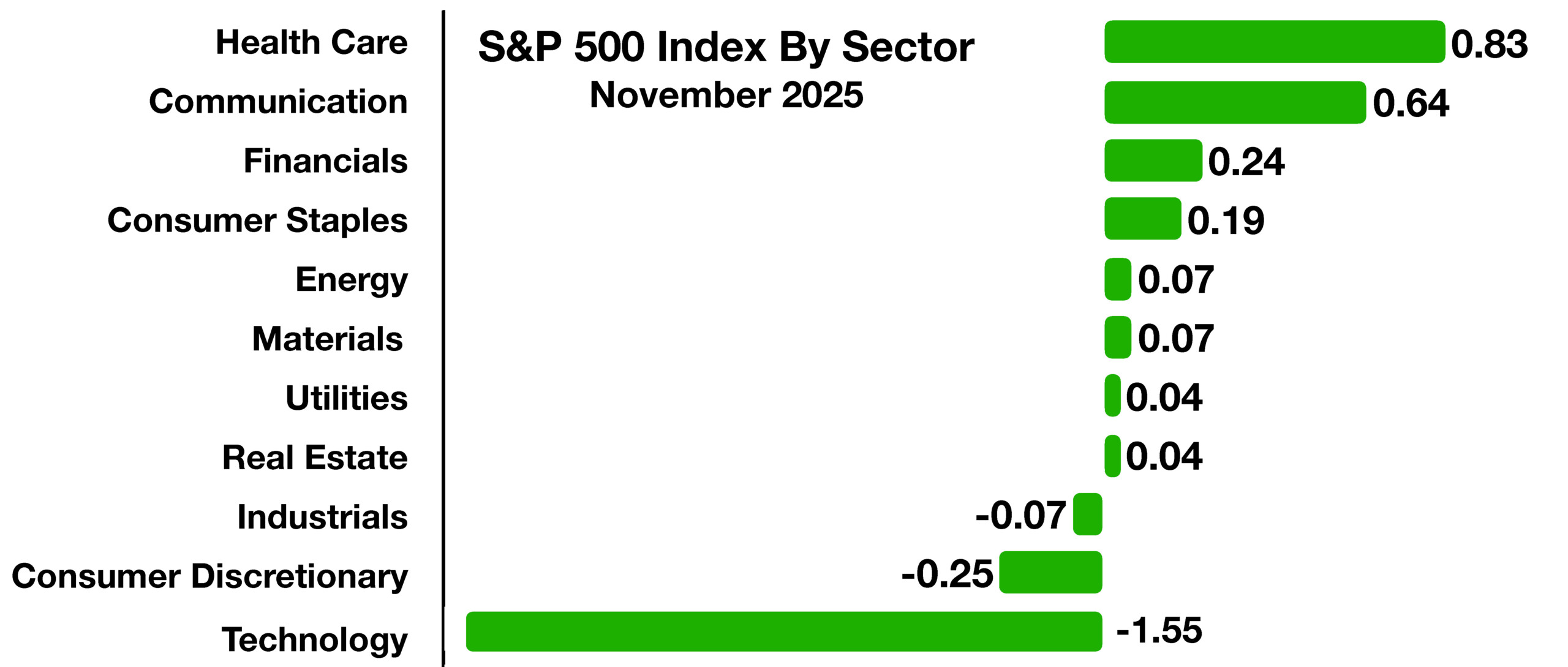
 
the Health care sector added 0.83% to the S&P 500 Index In November

Equity Markets Demonstrate A Rotation In November – Equity Overview

Markets grew increasingly volatile in November as major technology firms outlined massive capital expenditures, largely financed through substantial debt issuance. Analysts remain uncertain about how long it will take for these sizable investments to generate returns.

The healthcare sector buoyed the S&P 500 in November, while technology weighed on the index. Healthcare added 0.83%, whereas technology accounted for a 1.55% decline. Analysts view these shifts as evidence of sector rotation—a move toward steadier, less volatile industries.

Additional signs of rotation emerged as industrial and consumer discretionary sectors posted losses for the month, signaling a retreat from economically sensitive areas. (Source: S&P, Bloomberg)

Rates Aren’t Falling As Quickly As Hoped – Fixed Income Overview

Bond markets are on track for their strongest year since 2020, as falling rates and robust demand have fueled gains across nearly all sectors.

Treasury investors have increasingly relied on private payroll data in the absence of official government figures. With government reporting disrupted, private metrics have begun shaping bond-market sentiment over the past two months.

Analysts expect the Federal Reserve to slow the pace of rate cuts and extend the timeline for reductions, tempering hopes for more aggressive easing. The strain on consumer loans and small-business debt obligations could deepen already challenging conditions. (Sources: Treasury Dept., Federal Reserve)

Year End Gifts – Tax Planning

Individuals can give up to $19,000 in cash or property to any number of recipients in 2025 without filing a gift-tax return or tapping their lifetime exemption. The limit applies per recipient, allowing married couples to combine gifts for a total of $38,000 to any individual without triggering reporting requirements. Gift-tax liability falls on the donor, not the recipient.

Most taxpayers avoid gift tax entirely thanks to the sizable lifetime exemption—currently $13.99 million for individuals and $27.98 million for couples. The IRS requires Form 709 for gifts exceeding the annual exclusion of $19,000 to track how much of the lifetime exemption has been used. (Source: IRS)


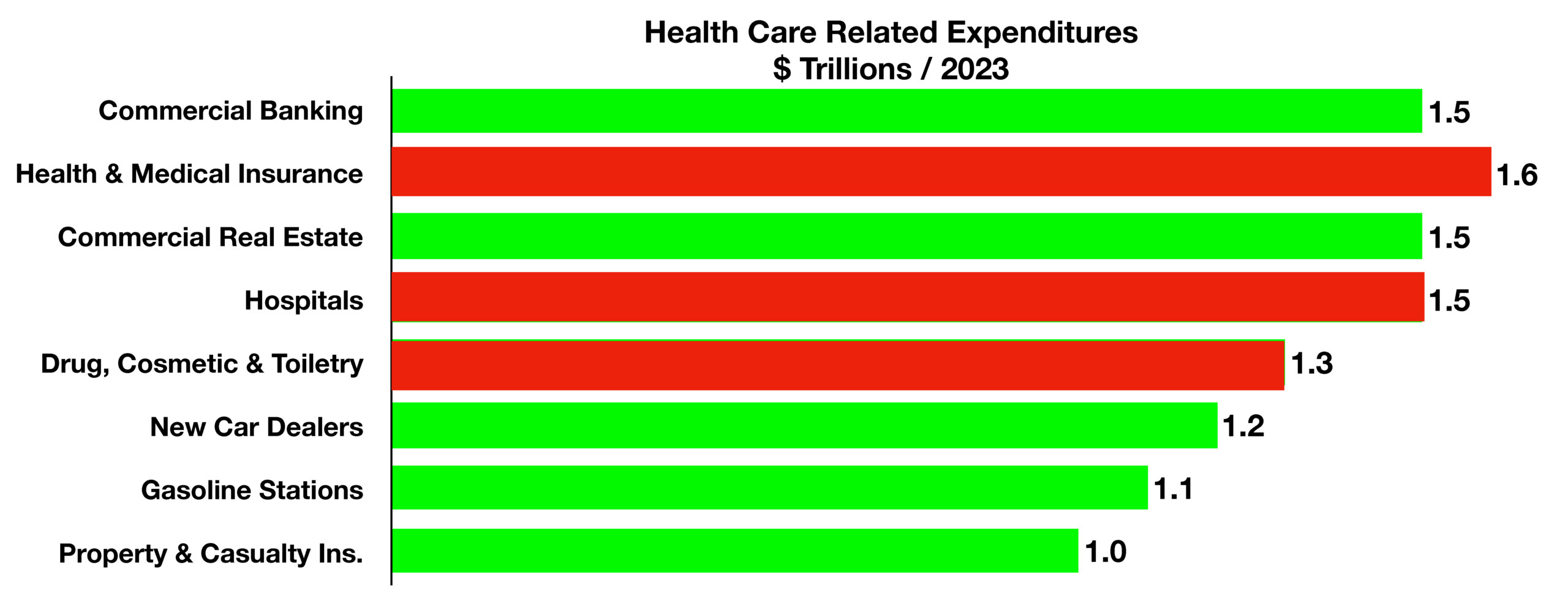
national health expenditures reached about $4.9 trillion in 2023

How The Health Care Industry Reinforces The U.S. Economy – Sector Analysis

The U.S. health-care industry underpins the economy by accounting for a significant share of national spending, creating millions of jobs, and boosting productivity through improved health and workforce capacity. It is both a major economic sector and a foundation for growth across other industries.

Health care ranks among the largest U.S. sectors, with national expenditures reaching roughly $4.9 trillion in 2023—about 18% of gross domestic product. This scale means decisions on pricing, coverage, and efficiency have direct implications for economic growth and government budgets.

About 11% of American workers are employed in health care, spanning hospitals, clinics, and long-term care facilities. These jobs generate substantial payrolls and support local economies through hospital spending, supplier contracts, and employee consumption.

Health-care spending drives growth by improving population health, which raises labor productivity and reduces absenteeism and disability. Broader insurance coverage can expand labor supply and ease job transitions, fostering more efficient markets and higher long-run GDP.

As a major component of federal and state budgets, health care accounts for roughly one-quarter of government spending through programs such as Medicare and Medicaid. While rapid cost growth creates fiscal strain, these programs also channel income to providers and communities, sustaining employment and stabilizing demand during downturns.

The industry also fuels innovation in pharmaceuticals, medical devices, and health technologies, generating high-value exports and spin-off sectors. Economists estimate that continued improvements in health care could add trillions of dollars to U.S. economic output over coming decades. (Sources: Federal Reserve, Dept. of Labor)

Gold Is Off Its Highs – Commodity Overview

Gold has long been a favored hedge against inflation, but the market is taking on new characteristics. The surge of gold exchange-traded funds and the introduction of cryptocurrency products backed by gold have fueled demand for the metal. Some analysts remain skeptical of these newer offerings, particularly amid this year’s sharp price rally.

Trading remains active, with volatility driven by macroeconomic shifts, central-bank policy, and geopolitical risks. Gold pulled back from its October highs after hitting $4,359 an ounce on Oct. 20, closing the month at $4,013. (Source: Federal Reserve)


the average 30-year mortgage hit a high of 7.24% in November 2023

Concerns Heading Into 2026 – Economic Dynamics

Uncertainty across multiple fronts has intensified this year, highlighting what consumers and markets fear most.

Tariffs — The fate of tariffs imposed earlier this year rests with the Supreme Court, which is expected to rule by the end of its current term in June 2026.

Fed Rate Cuts — Internal divisions among Federal Reserve officials have led analysts to anticipate a slower pace of rate reductions and a lengthier process.

Inflation — Consumers expect elevated prices for goods and services to persist into 2026, weighing on discretionary spending.

Jobs & Income — Labor-market weakness is translating into layoffs and muted wage growth, adding stress to already anxious households.

Interest on Debt — High credit-card, mortgage, and auto-loan rates are curbing spending among consumers burdened by steep monthly payments.

Geopolitical Tensions & Global Conflicts — Heightened uncertainty reinforces concerns over energy prices, supply chains, and potential economic shocks.

As a result, consumers are prioritizing essentials, seeking value and promotions, and delaying or cutting back on discretionary purchases such as dining out, furniture, and electronics. (Sources: Reuters, Bloomberg)

Housing Market Is Among The Least Affordable In U.S. History – Housing Market

Measured by the Housing Affordability Index, home affordability has steadily declined since early 2021. Key factors include home prices, mortgage rates, and household incomes. With inflation outpacing wage growth, U.S. buyers have struggled to keep pace with rising costs and borrowing rates.

When the Federal Reserve raises interest rates to curb inflation, mortgage rates typically follow. The average 30-year mortgage climbed to 7.24% in November 2023—the highest since 2001—compared with the record low of 2.65% in 2021. Elevated rates have created a far less affordable environment for buyers, limiting access to homeownership.

Sources: National Association of Realtors, Federal Reserve Bank of St. Louis, Freddie Mac