W.P. "Bill" Atkinson, III

Certified Financial Planner TM / Attorney

Access Financial Resources, Inc.

3621 NW 63rd Street, Suite A1

Oklahoma City, OK  73116

(405) 848-9826

www.afradvice.com / bill@apaplans.com

January 2026
Market Update
(all values as of 12.31.2025)

Stock Indices:

Dow Jones 48,063
S&P 500 6,845
Nasdaq 23,241

Bond Sector Yields:

2 Yr Treasury 3.47%
10 Yr Treasury 4.18%
10 Yr Municipal 2.73%
High Yield 6.48%

YTD Market Returns:

Dow Jones 13.07%
S&P 500 16.46%
Nasdaq 20.36%
MSCI-EAFE 27.89%
MSCI-Europe 31.95%
MSCI-Pacific 29.87%
MSCI-Emg Mkt 30.58%
 
US Agg Bond 7.30%
US Corp Bond 7.77%
US Gov’t Bond 6.88%

Commodity Prices:

Gold 4,325
Silver 70.34
Oil (WTI) 57.42

Currencies:

Dollar / Euro 1.17
Dollar / Pound 1.34
Yen / Dollar 156.18
Canadian /Dollar 0.73

Macro Overview

Pronounced uncertainty throughout 2025 created volatile trading sessions, as labor market concerns and lingering inflation kept the Fed from lowering rates to the extent that had been expected. Regardless, both equity and fixed income markets rose throughout the year, driven by consistent earnings and optimism surrounding massive investment and capital expenditures related to Artificial Intelligence (AI).

Tariffs remained a focal point of contention in 2025, as economists struggled to determine how much of an effect tariffs have had on consumers and U.S. companies. A study by the Federal Reserve Bank of San Francisco concluded that the tariffs imposed in April 2025 actually resulted in lower inflation and higher unemployment, primarily due to uncertainty surrounding the tariffs.

Geopolitical tensions in Europe, the Middle East, and Asia drove skepticism about international trade and commodity prices. An ounce of silver cost more than a barrel of oil at the end of 2025—the first time this price disparity has occurred since 1980, when the infamous Hunt brothers cornered the silver market. Silver reached $70 per ounce, and oil closed at just over $57 per barrel at the end of 2025.

The U.S. dollar lost ground in 2025, driven by concerns over excessive U.S. debt and uncertainty surrounding fiscal initiatives. A weakening dollar increases import costs for consumers, yet is beneficial for U.S. exporters, as U.S. exports become more affordable.

Cryptocurrencies experienced a pullback toward the end of 2025, as leveraged digital currency positions unraveled. Rampant speculation among crypto traders created tremendous volatility throughout the year. Cryptocurrencies experienced gains early in the year, followed by a sharp correction late in the year. Regulatory clarity and institutional adoption continue to be leading concerns surrounding digital currencies.

The President proposed that the federal government buy approximately $200 billion of mortgage bonds through housing authorities Fannie Mae and Freddie Mac, in an effort to push mortgage rates down and increase affordability for buyers. Buying mortgage bonds in the open market curtails the supply of bonds, which can lead to lower mortgage rates. (Sources: U.S. Treasury, Federal Reserve, Fannie Mae)
 
California currently has the highest income tax rate at 13.3%

Bond Prices Edge Higher in 2025 – Fixed Income Markets Overview

Fixed income markets across various sectors had a favorable year, with bond prices advancing in 2025. U.S. Treasuries, investment-grade corporates, and high-yield bonds all rose in price as the Fed teetered on easing rates throughout the year, with confirmation of a lower-rate trend toward the end of 2025.

The Fed’s trajectory, along with still-attractive bond yields in 2025, drove demand throughout the year. Uncertainty in the equity markets added to demand for bonds, as volatility led investors to seek confirmation in fixed income.

The 10-year Treasury yield finished the year at 4.18%, down from its peak of 5% in October 2023. Bonds had their best year since 2020, when the pandemic drove funds toward bonds as a safe haven and a source of stability. (Sources: U.S. Treasury, Federal Reserve)

Equities Advance in 2025 – Domestic Equity Market Overview

Equities were resilient throughout 2025, as uncertainty surrounding tariffs, geopolitical tensions, and Fed rate cuts induced volatile trading sessions. The Dow Jones, S&P 500 Index, and the Nasdaq all posted strong performance results for the year, exceeding most analysts’ expectations.

Massive capital injections by numerous technology companies into AI led to broad appreciation in sectors and industries associated with AI expansion. The spillover from AI investment benefited companies with indirect ties to AI, similar to what occurred in the late 1990s and early 2000s as the internet expanded. (Sources: Dow Jones, S&P, Nasdaq, Bloomberg)

Nine States Reduce Their State Income Tax Rates for 2026 – Fiscal Tax Policy

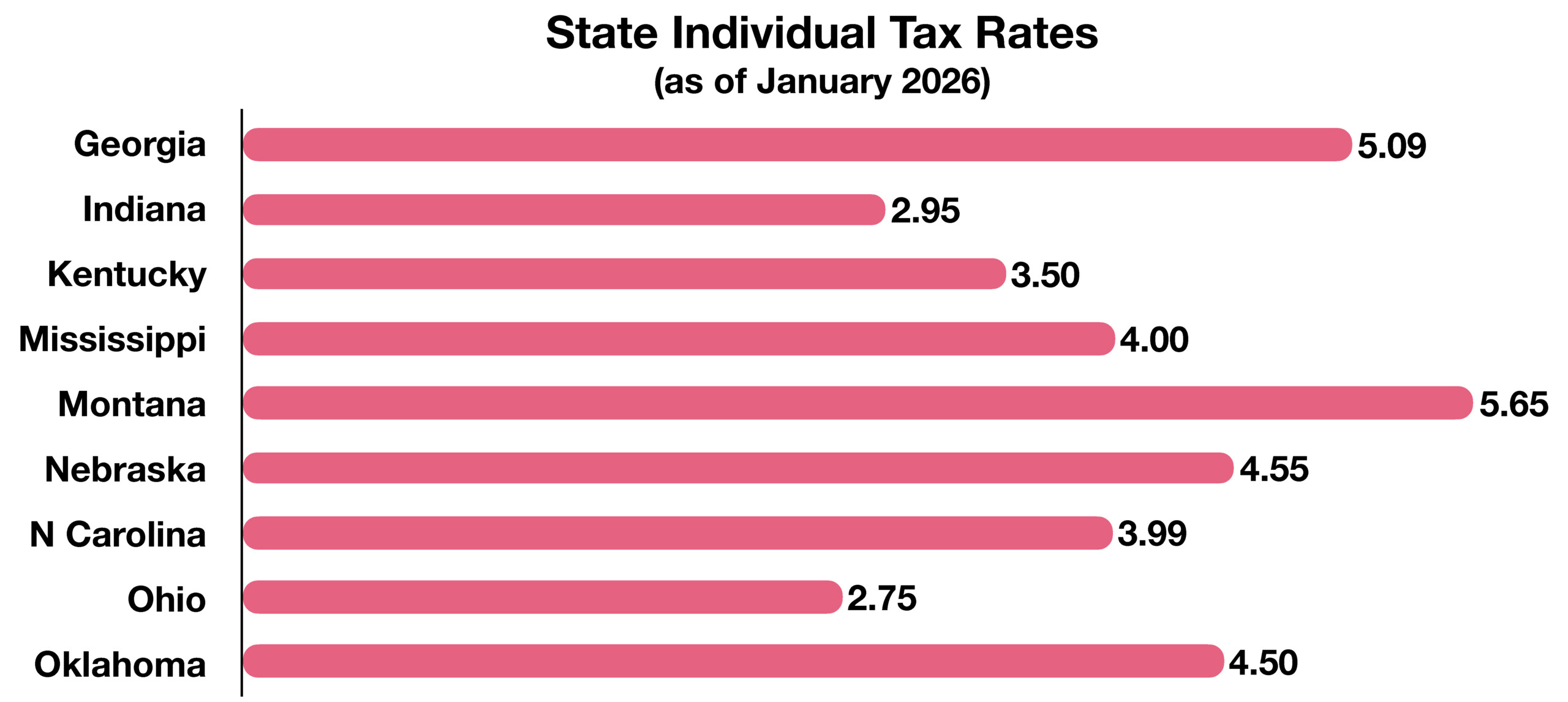
For tax year 2026, nine states are reducing their individual state income tax rates: Georgia, Indiana, Kentucky, Mississippi, indicating this lists, Montana, Nebraska, North Carolina, Ohio, and Oklahoma. The tax cuts apply to individual taxpayers living in each respective state.

Most of these nine states have established planned decreases in tax rates over the next few years, aiming to ease tax burdens on current residents and incoming taxpayers. There are currently nine states with no state income tax, some of which had taxes (or higher tax rates) in place before eliminating them. California currently has the highest tax rate at 13.3%, followed by Hawaii at 11%, and New York at 10.9%. Source: Tax Policy Center

 
AI helped propel the S&P 500 index in 2025

How AI Is Affecting the Economy – Technology & The Economy

Artificial intelligence (AI) is currently boosting U.S. economic growth and market valuations, while also creating valuation risks, labor disruption, and energy challenges.

AI-related investment in software, semiconductor chips, data centers, power infrastructure, and networking has already added on the order of hundreds of billions of dollars to U.S. GDP since late 2022, with one estimate putting the contribution at around $250 billion.

Economists expect AI to raise productivity, though unevenly across industries, as companies integrate AI into manufacturing, production, and services.

Thus far, AI appears to be a minor factor in the 2025 labor-market slowdown, but economists expect that wider diffusion could displace some jobs even as it creates new tasks and demand in other roles. Policymakers and researchers note that the main near-term macro risk is not mass unemployment, but the need for retraining, regional dislocation, and pressure on lower-skilled occupations.

AI has been a dominant equity theme, helping propel S&P 500 performance in 2025, with a large share of returns concentrated in AI-linked megacap tech, data-center, chip, and cloud companies. Regulators and analysts are considering whether AI-driven optimism encourages excessive leverage or speculative behavior in equity and credit markets, which could amplify any downturn. At the same time, broader adoption of AI across sectors is seen as a potential cushion against shocks, making the U.S. economy somewhat more resilient if productivity effects materialize as expected.  (Sources: RPS, Current Population Survey, Bureau of Labor Statistics, St. Louis Fed)

What Happened To Consumer Confidence in 2025 – Consumer Behavior

The beginning of 2025 revealed that consumers were optimistic because of low unemployment, ongoing job growth, and stable inflation. Yet by the end of 2025, optimism had fallen sharply, with more consumers reporting pessimism and caution about the economy as inflation, job scarcity, and living costs increased concerns.

The University of Michigan Consumer Sentiment Index stood at 64.7 in January 2025, then fell to 51.0 by November, eventually edging up to 52.9 in December—leaving sentiment well below historical norms.
Behavior and spending signals in 2025 found more consumers opting for cheaper goods and prioritizing essentials, with many cutting back on discretionary purchases and major expenditures.

By the fourth quarter of 2025, sentiment was about 30% below its late-2024 peak, underscoring how uneasy consumers felt heading into 2026.  (Source: University of Michigan Consumer Sentiment Index; FRED)

 
the u.s. dollar fell roughly 9.5% in 2025

Dollar’s Decline in 2025 Was Largest Since 2017 – Currency Overview

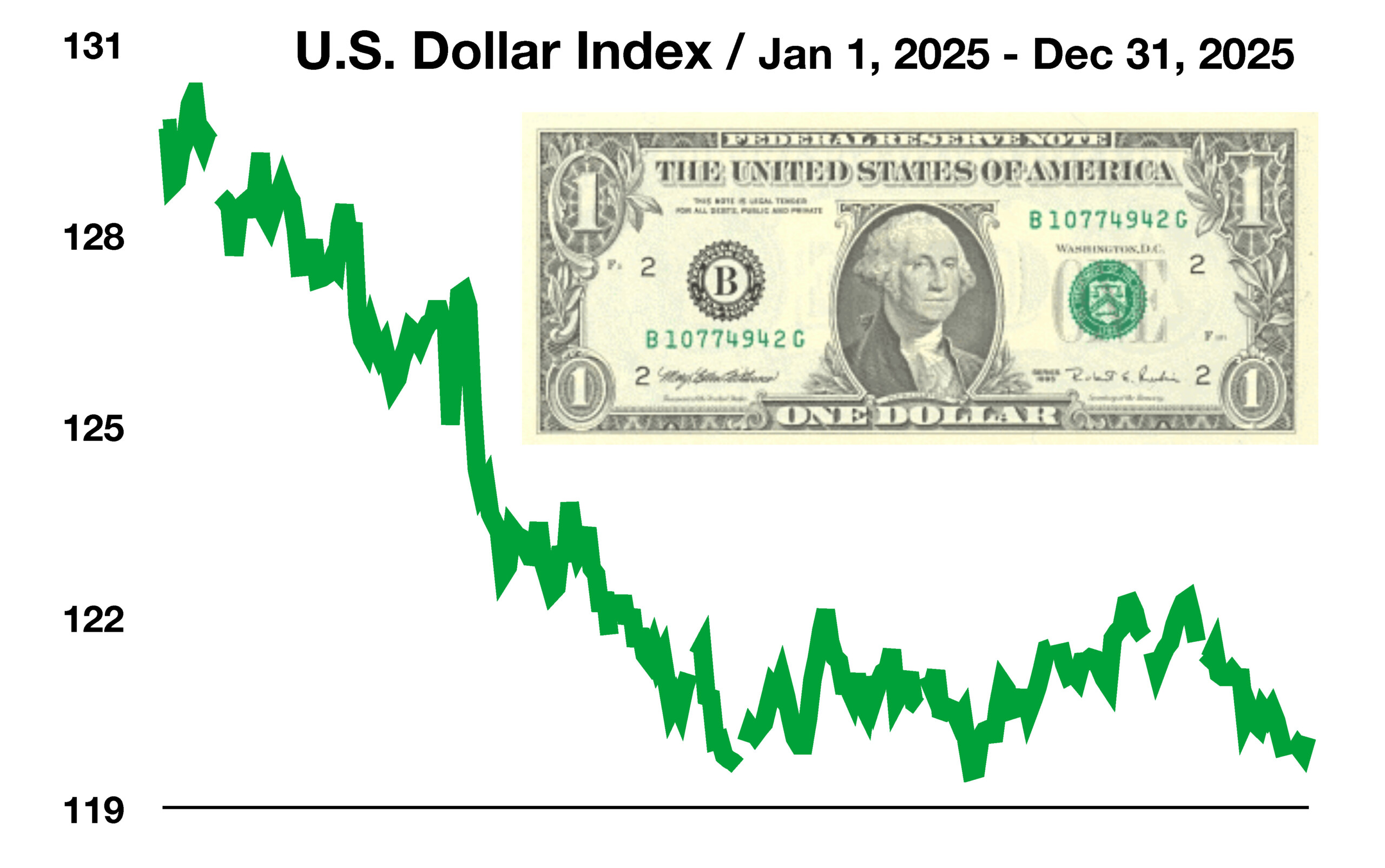
In 2025, the U.S. dollar had a notably weak year and underperformed most other major currencies, with broad indexes showing its largest annual drop since 2017 and one of the steepest declines in decades.

The U.S. Dollar Index, which tracks the dollar against six major currencies (euro, yen, pound, Canadian dollar, Swiss franc, and Swedish krona), fell roughly 9.5% in 2025—the largest drop since 2017. Earlier in the year, the dollar was down about 11%, marking the biggest first-half loss since the 1970s.

Factors affecting the dollar in 2025 include slower U.S. growth expectations, high fiscal deficits, policy uncertainty regarding tariffs, political tensions, and shifting global capital flows away from U.S. assets. Easing U.S. interest rates also reduced the yield advantage of dollar assets, making the dollar less attractive relative to other major currencies. (Sources: Federal Reserve Bank of St. Louis)

What Are Rare Earth Materials – Commodities Review

Rare earth materials are minerals or compounds that contain one or more rare earth elements, which comprise 17 metallic elements used extensively in modern technologies. These materials are important because they provide unique magnetic, optical, and catalytic properties that are hard to substitute in many high-tech applications.

These elements are relatively abundant in the Earth’s crust, but they are rarely found in concentrated deposits, which makes mining and separation difficult. The term “rare earth” comes from the early discovery of these elements in unusual mineral “earths” and from the scarcity of economically viable deposits—not from a true rarity in nature.

Rare earth materials are essential in magnets for wind turbines and electric vehicles, in smartphone components, and in computer hard drives. They also appear in glass-polishing powders; catalysts for oil refining and vehicle emissions treatment; phosphors in LED and fluorescent lighting; and components for lasers and fiber-optic communication. Overall, rare earth materials underpin many modern technologies—especially powerful magnets, specialized lighting, displays, and advanced electronics—helping make devices smaller, more efficient, and more energy-saving. (Sources: U.S. Department of the Interior, CIA World Factbook)