Michael McCormick
5 West Mendenhall, Ste 202 | Bozeman, MT 59715
406.920.1682 mike@mccormickfinancialadvisors.com
Sustainable Income Planning | Investments | Retirement
| Dow Jones | 52,319 |
| S&P 500 | 7,499 |
| Nasdaq | 26,213 |
| 2 Yr Treasury | 4.14% |
| 10 Yr Treasury | 4.44% |
| 10 Yr Municipal | 2.89% |
| High Yield | 6.99% |
| Dow Jones | 8.85% |
| S&P 500 | 9.55% |
| Nasdaq | 12.79% |
| MSCI-EAFE | 7.74% |
| MSCI-Europe | 5.92% |
| MSCI-Far East | 12.84% |
| MSCI-Emg Mkt | 22.68% |
| US Agg Bond | 0.61% |
| US Corp Bond | 0.85% |
| US Gov’t Bond | 0.49% |
| Gold | 4,010 |
| Silver | 58.85 |
| Oil (WTI) | 70.08 |
| Dollar / Euro | 1.14 |
| Dollar / Pound | 1.32 |
| Yen / Dollar | 161.86 |
| Canadian /Dollar | 0.70 |
Dear Friends,
Summer has certainly arrived. With record temperatures making headlines around the world, it’s easy to feel like everything is running hot—including the stock market.

Sticking with the plan.
Despite widespread expectations that markets might struggle this year, disciplined investors have once again been reminded of an important principle: successful investing is built on patience, planning, and staying committed to a well-designed strategy. While no one can predict short-term market movements with certainty, history has consistently rewarded those who remain focused on their long-term goals. With the exception of some areas of fixed income and real estate, most major asset classes have delivered solid returns. The ongoing cycle of investment in artificial intelligence and technology, corporate spending, and strong earnings has helped support market performance, even in the face of unsettling headlines.
Of course, every market cycle eventually changes. That’s why prudent financial planning isn’t about chasing returns—it’s about being prepared. Benjamin Franklin is often credited with observing that among life’s faithful companions are “a good wife, a good book, and ready money.” Ready money simply means having access to safe, liquid assets when you need them most. It provides flexibility, peace of mind, and financial independence.
Today, competitive money market funds are offering yields of around 3.6%, making them an attractive home for emergency reserves and short-term savings. Once that foundation is in place, however, long-term financial plans generally require continued investment in equities to pursue growth that outpaces inflation over time. Investing can feel uncomfortable when markets are reaching new highs, particularly for those who remember the financial crisis of 2008. Yet history has shown that time in the market has been a more reliable driver of long-term success than attempting to time the market.
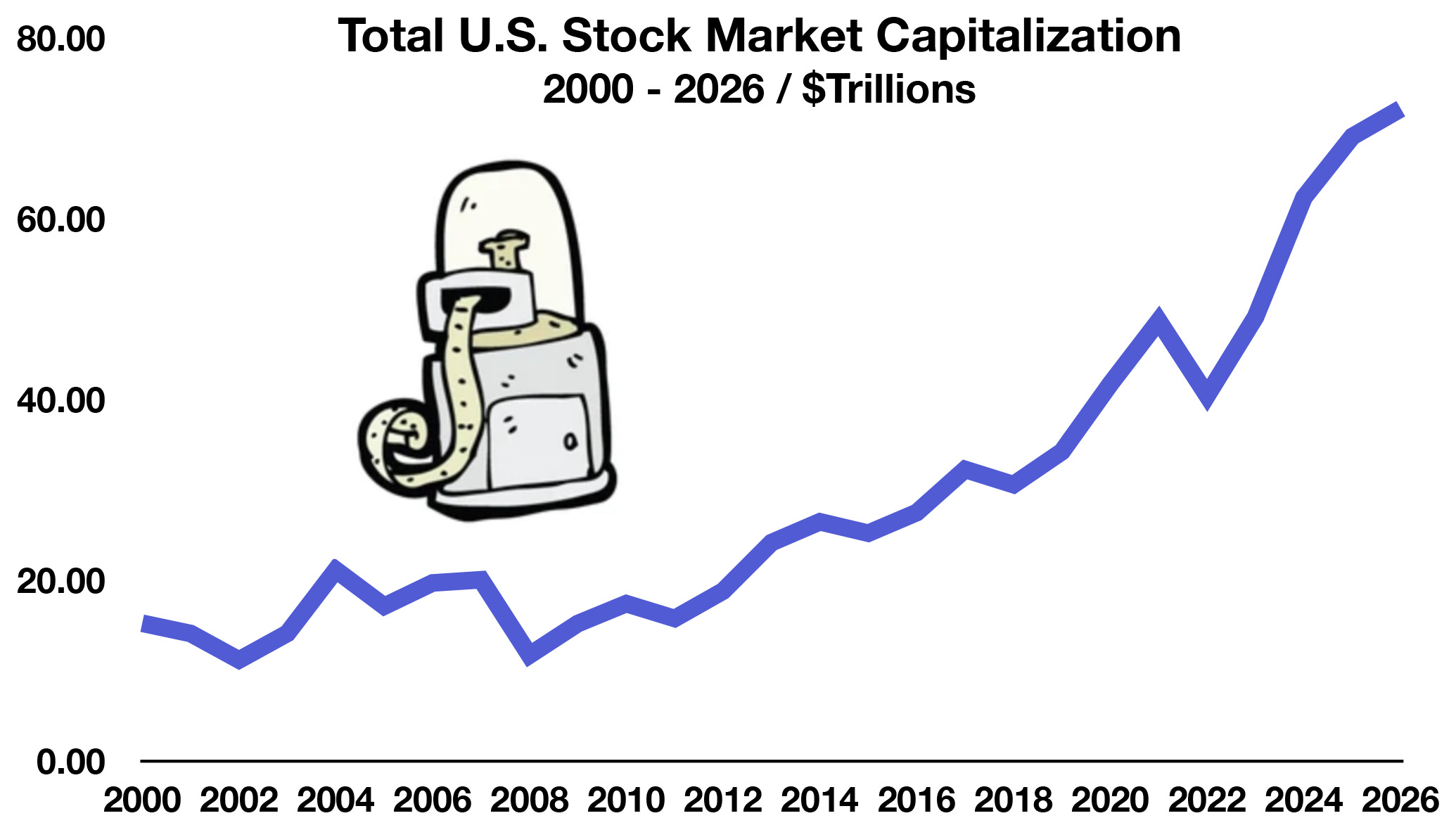
Total Stock Market Valuation Surpasses $70 Trillion – Domestic Equity Overview
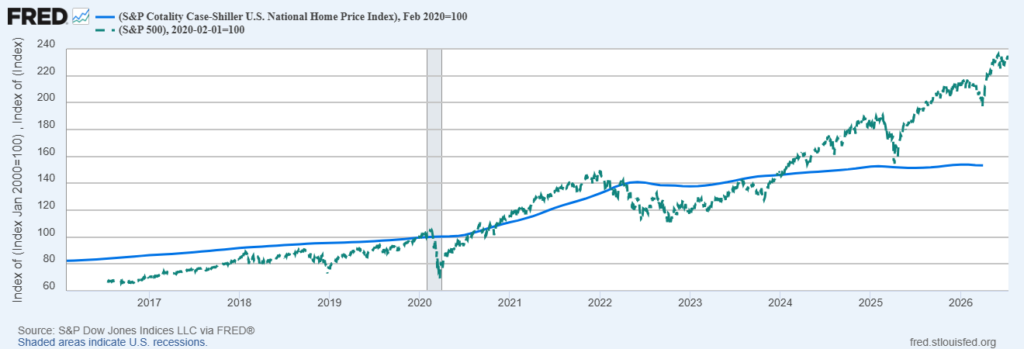
Domestic stocks rebounded in May following a volatile first four months of the year. The S&P 500 Index propelled forward in May with advances primarily driven by the technology, consumer discretionary, and healthcare sectors. Current market momentum is being driven by earnings and optimism surrounding the continued build-out of AI infrastructure. Elevated rates are starting to take a toll on various smaller capitalized stocks, which have inherently more debt at higher interest payments.

Currently, total market capitalization of the U.S. stock market is roughly $72 trillion, reflecting the combined value of all publicly traded U.S. companies listed on major exchanges such as the NYSE and Nasdaq, while also accounting for nearly half of the entire global equity market.
The U.S. is the largest single concentration of corporate wealth in the history of the world, representing nearly half of the roughly $154 trillion global stock market capitalization. The U.S. market dwarfs the next largest global markets followed by China with about $11.8 trillion total market value and the European Union with an approximate $11.1 trillion capitalization. Sources: Dow Jones, S&P, IMF
Volatile Oil Prices Create Uncertainty- Energy Sector Overview

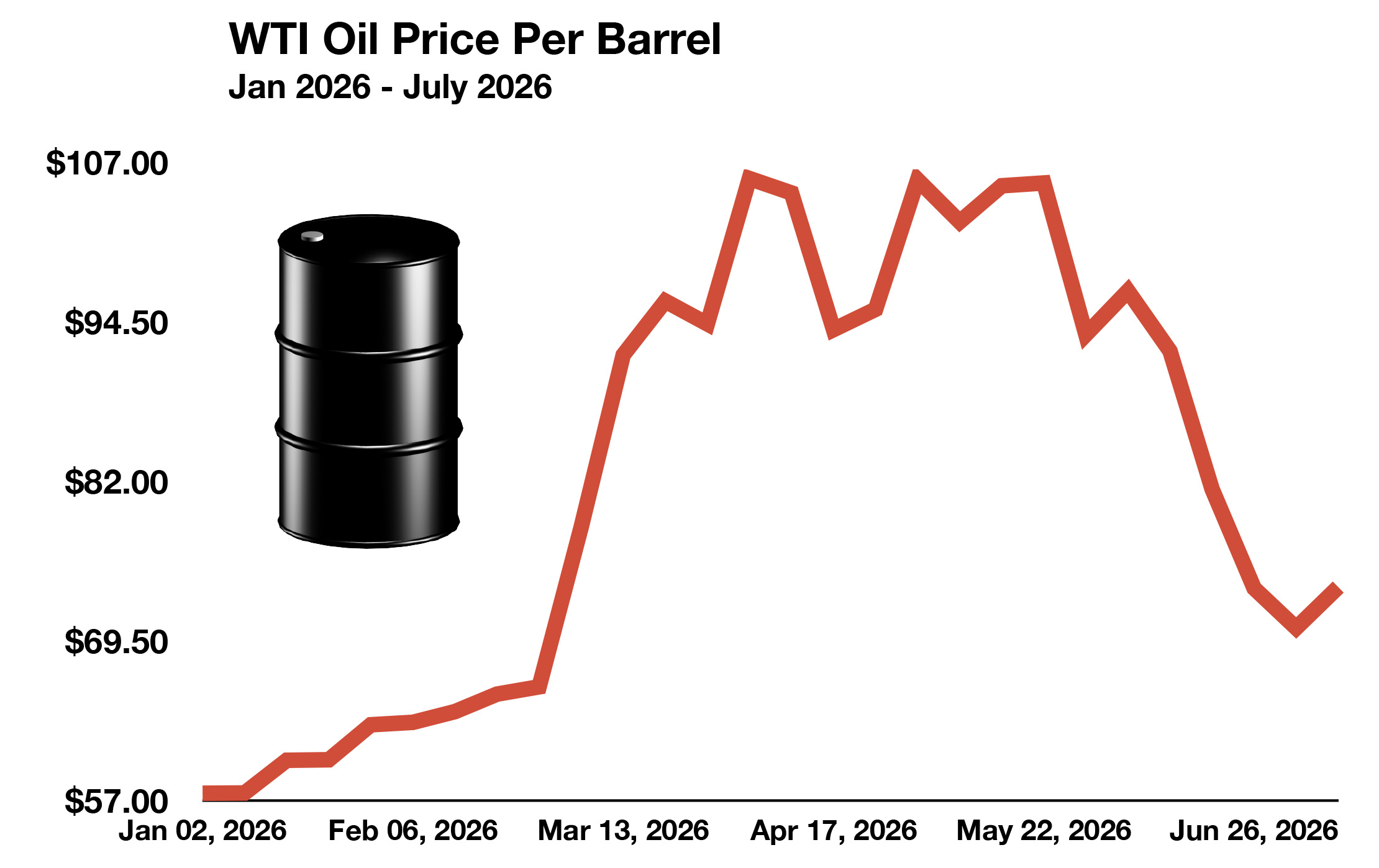
With oil falling nearly 40% from its highs in April as a result from the contentious cease fire with Iran in June, an expectation has arisen that gasoline prices will soon fall as well. An ensuing drop in gasoline and diesel prices would alleviate inflationary pressures, thus giving consumers a much needed break. Some analysts believe that if this should occur, the Fed’s stance on inflation might very well change course, perhaps in the direction of even a rate reduction towards the end of the year. Fuel consumption makes up roughly 8% of the Consumer Price Index (CPI), which measures the rate of inflation for U.S. consumers. Lower diesel and gasolines prices also affect the price of goods and products, such as food and merchandise, which are transported nationally by rail and truck.
Sources: EIA, BLS, Dept. of Labor, Dept. of Transportation
New Rules Surrounding 401k Catch Up Contributions in 2026 – Retirement Planning
Being mid-year, it is wise to review retirement plan contributions and any imposed limits in order to plan accordingly.
Effective this year, if you’re age 50 or older and had $150,000 or more in prior-year FICA wages from an employer sponsored plan, your 401(k) catch-up contributions must be made as Roth contributions starting in 2026. If you earned less than that, you can generally keep making catch-up contributions pre-tax or Roth, depending on your company plan’s options.
The catch-up contribution limit for 2026 is $8,000 for employees age 50 and older, and the total 401(k) employee deferral limit is $24,500. For ages 60 to 63, there is an enhanced catch-up limit of $11,250 if the company plan allows it.
The Roth-only catch-up rule applies to the catch-up portion only, not regular salary deferrals. It is based on the prior year’s wages from that same employer, and if the company plan does not offer a Roth 401(k) option, employees may not be able to make catch-up contributions under the rule.
Source: IRS.gov
Trump Accounts / Effective July 4th – Financial Planning For Children
Trump Accounts are a newly introduced federal investment program designed to help children begin building wealth from an early age. Trump Accounts became eligible to accept initial contributions on July 4, 2026.
These accounts are expected to provide eligible children born between January 1, 2025, and December 31, 2028, with a one-time $1,000 government contribution, which can then remain invested in addition with future contributions from parents, family members, employers, and other eligible sources.
The intention behind the accounts is to help encourage long-term investing, by giving children early exposure to U.S. stock market investments tracking a qualified index, such as the S&P 500 Index. The concept is an early start gives investments more time to grow, with even small contributions potentially increasing in value over decades via the dynamics of compound growth and tax deferred accumulation.
Under current legislation, the accounts are structured similarly to traditional individual retirement accounts (IRAs), with a parent or guardian serving as custodian until the child reaches the age of 18. After age 18, many of the withdrawal restrictions no longer apply and the account generally operates similar to a traditional IRA.
Parents, family members, employers, charities, and other eligible contributors may contribute up to $5,000 annually per child. Account assets are limited to certain low-cost index funds tracking the U.S. stock market. Withdrawals are restricted until the child reaches the age of 18.
Examples of future growth illustrations along with projected account accumulation amounts are provided by the United States Government at https://trumpaccounts.gov/.
Sources: U.S. Government, https://trumpaccounts.gov/
Free Money Tip – Trump accounts are now available for children born between 2026 and 2028. It’s not simple, but there are significant benefits beyond the $1,000 handout. If there is a new human in your life, please take time to educate yourself regarding this opportunity.
About Us
Our clients enjoy the feeling of having their financial lives kept in order. Freedom from worry comes from working with an experienced advisor that understands your entire financial life and is accessible and attentive to your needs. As a fiduciary, Mike is unable to receive commissions from financial products and free to make recommendations that are unbiased by Wall Street. With over a decade of experience caring for a small family of clients, our specialties are preserving wealth and generating sustainable income. Our average client net worth ranges from $5 to $30 Million. Go outside, we’ve got this.
Cancel or move to digital? mike@mccormickfinancialadvisors.com with your preference. No worries!