Fortis Wealth Management

(888) 336-7847 (3FORTIS)

www.investfortis.com

November 2026
Market Update
(all values as of 10.30.2026)

Stock Indices:

Dow Jones 51,770
S&P 500 7,580
Nasdaq 25,437

Bond Sector Yields:

2 Yr Treasury 4.56%
10 Yr Treasury 4.94%
10 Yr Municipal 3.40%
High Yield 8.14%

YTD Market Returns:

Dow Jones 7.71%
S&P 500 10.73%
Nasdaq 9.44%
MSCI-EAFE 7.19%
MSCI-Europe 4.13%
MSCI-Far East 14.29%
MSCI-Emg Mkt 11.55%
 
US Agg Bond -0.46%
US Corp Bond -1.02%
US Gov’t Bond -0.60%

Commodity Prices:

Gold 3,884
Silver 49.27
Oil (WTI) 104.12

Currencies:

Dollar / Euro 1.11
Dollar / Pound 1.33
Yen / Dollar 157.84
Canadian /Dollar 0.71
 

Macro Overview

Markets reacted to the growing possibility of a more stringent regulatory environment for the AI and energy sectors. Voters in several states urged candidates to curb data-center development to help ease rising electricity costs tied to the rapid expansion of AI infrastructure. AI-related companies have become increasingly dependent on reliable supplies of electricity and natural gas. Without adequate energy resources, AI development could slow.

Expanding power plants and generation capacity takes time, leaving new supply unlikely to arrive in the near term. Until then, electricity costs in some regions may continue to rise as some data centers compete with households and businesses for available power.

According to U.S. Census Bureau data, business activity expanded at its fastest pace in more than five years as demand drove growth in manufacturing. Factory output increased across industries including machinery, computer and electronic products, transportation equipment and chemicals. Economists often view such data as a leading indicator of future economic growth.

Investors have been evaluating how AI could boost corporate earnings and improve operating efficiency across industries. If new or renewed regulations constrain data-center development or energy production, earnings estimates for many companies in major stock indexes could come under pressure.

The nationwide buildout of data centers is increasing demand for key materials such as concrete, copper and steel. Rising costs for those materials are contributing to inflationary pressures in housing and construction.

Saudi oil production has fallen nearly 50% since the start of the year, raising questions about OPEC’s long-term outlook. For decades, Saudi Arabia has been OPEC’s largest producer and a pillar of the organization’s influence in global energy markets.

U.S. pending home sales fell 7.3% in September to their lowest level since 2001, according to Census Bureau data. Elevated mortgage rates and stagnant wage growth continue to weigh on housing demand nationwide.

The average employer-sponsored family health insurance plan now costs $28,303 a year, representing a significant expense for millions of households. Premiums are expected to rise further in 2027 as higher costs affect both group and individual plans.

The U.S. Department of the Treasury completed automatic enrollment for Trump Accounts, establishing tax-advantaged accounts for nearly 70 million eligible children under age 18 with a valid Social Security number. U.S. citizens born between Jan. 1, 2025, and Dec. 31, 2028, qualify for a one-time federal contribution of $1,000. To receive the contribution, parents must claim the account and submit IRS Form 4547.

Sources: Treasury Dept., Census Bureau, Bloomberg, Statistics of U.S. Businesses (SUSB)

 
saudi oil production has fallen by almost 50% since the beginning of the year

Volatility Hinders Momentum – Equity Overview

A shift toward large-cap value stocks and away from growth-oriented companies emerged in October as investors trimmed positions in AI-related holdings. A growing number of analysts believe the move toward less volatile, more defensive sectors has been building in recent weeks. While gradual rather than abrupt, the trend has become increasingly apparent to market participants.

Hedge funds have increased short positions in a growing number of stocks, betting on declines in share prices. Some analysts believe the elevated level of short interest could set the stage for a short squeeze, forcing investors to buy back shares quickly to cover their positions.

October’s rotation into dividend-paying stocks from growth-oriented shares highlighted widening disparities within the equity market, with the energy and communications sectors occupying opposite ends of the performance spectrum. (Sources: S&P, Dow Jones, Bloomberg)

Direction of Interest Rates – Fixed Income Update

Bond yields declined in October as investors moved toward more conservative, safe-haven assets. Treasury bonds attracted increased demand during the month as risk-averse investors shifted capital from equities into fixed income. Debt issued by AI-related companies now accounts for roughly 15% of the investment-grade corporate bond market. The sector has become an important focus for bond investors, as the earnings performance of AI companies increasingly influences its underlying fundamentals.

Federal Reserve officials continue to monitor labor-market conditions and persistent inflationary pressures. Together, those factors have become key determinants of the direction of interest rates. (Sources: Treasury Department, Bloomberg, Federal Reserve)

Saudi Oil Production Drops – Oil Industry Update

Saudi Arabia’s oil production has fallen sharply since the beginning of 2026, declining by more than 4 million barrels per day. For decades, Saudi Arabia was OPEC’s largest oil producer, consistently outpacing every other member of the cartel. That dominance, long a cornerstone of OPEC’s influence over global energy markets, has recently come under pressure.

OPEC lost the United Arab Emirates as one of its key member countries earlier this year and now faces the potential departure of Venezuela. A growing number of energy analysts believe the organization could continue to weaken as strains emerge within its cartel structure. For decades, Saudi Arabia’s oil industry has relied heavily on drilling and exports as its primary sources of revenue. The kingdom’s oil production has fallen by nearly 50% since the beginning of the year to about 6 million barrels per day. By comparison, U.S. oil production stands at roughly 14 million barrels per day, making the United States the world’s largest producer and exporter of oil. Saudi oil and energy infrastructure has sustained significant damage from attacks linked to Iran, disrupting both production and exports. Saudi Arabia’s alliance with the United States, combined with its proximity to Iran, has increased its exposure to attacks in recent weeks. (Sources: OPEC, U.S. Energy Department)

 
the national median household income in 2025 was $87,460

How Record Incomes In 2025 Varied By State – Demographics

Household income varies widely across states due to differences in industrial composition, economic conditions and labor-market dynamics. States with larger manufacturing sectors often have different income profiles than those with more agriculture-based economies. Earnings also vary significantly by industry, reflecting differences in skill requirements, education levels and job responsibilities.

The most recent payroll report from the U.S. Department of Labor showed payrolls increased in 14 states in 2025, while California was the only state to report a decline in median household income. Rhode Island, Virginia and Wyoming posted some of the strongest payroll gains, supported by growth in key industries. Such gains typically contribute to rising incomes, particularly during periods of economic expansion. While some states benefit from higher-paying, fast-growing industries, others remain more dependent on lower-paying sectors with slower growth. The national median household income reached a record $87,460 in 2025.

As the economy evolves, states that once ranked among the highest-income areas can experience relative declines. Michigan and West Virginia, for example, historically benefited from strong automotive, steel and coal industries. As those sectors contracted, average household incomes in both states came under pressure over time. Some analysts believe wage growth has begun to stagnate in certain industries as companies increasingly adopt AI-driven systems to perform tasks once handled by workers. Even so, it may be too early to determine the full impact of AI on wages and long-term income trends. (Source:   U.S. Labor Department)

Social Security Benefits Due To Increase – Retirement Planning

Social Security recipients are set to receive a 3.6% benefit increase in 2027, the largest annual adjustment since 2023. For many beneficiaries, however, much of the increase will be absorbed by higher living costs and rising Medicare premiums. The higher payments take effect in late December 2026 for Supplemental Security Income (SSI) recipients and in January 2027 for Social Security beneficiaries.

Many retirees are concerned that the increase may not keep pace with expenses that continue to rise faster than inflation, particularly for essentials such as food, housing and energy. Medicare Part B premiums are expected to increase 3.3% at the start of 2027, raising the standard monthly premium to about $209.50. In addition, premiums for stand-alone Medicare Part D prescription drug plans are projected to rise by roughly 50% in 2027.

Social Security was established on Aug. 14, 1935, when President Franklin D. Roosevelt signed the Social Security Act into law. Since then, the program has provided benefits to millions of Americans. Payments are adjusted automatically for inflation through the annual cost-of-living adjustment, or COLA, which has been in place since 1975. Benefit increases have varied over time, reflecting changes in the inflation rate. (Source:  Social Security Administration)

 
The average vehicle in 1949 achieved roughly 13 MPG

Largest Foreign Holders of Treasuries – Treasury Market Overview

As of Oct. 30, 2026, total U.S. government debt outstanding stood at $40.5 trillion, roughly double its level a decade earlier. Foreign investors hold about 23% of that debt, or nearly $10 trillion. The remainder is held primarily by U.S. government departments and agencies through what are known as intragovernmental holdings.

Federal debt is generally divided into two categories: debt held by the public, which includes domestic and foreign investors, and intragovernmental holdings, which are held by federal trust funds and government accounts. Intragovernmental holdings total roughly $8 trillion and are spread across more than 200 federal entities. These range from the Social Security Administration, which holds more than $2.4 trillion in Treasury securities, to agencies such as the Department of Energy, the Office of Personnel Management and the Department of State.

According to Treasury Department data, Japan, the United Kingdom and China are among the largest foreign holders of U.S. Treasury securities. Investors and policymakers continue to monitor China’s gradual reduction in Treasury holdings. Over the past year, China’s holdings have fallen from roughly $700 billion to less than $600 billion, a decline of about 14%. Some analysts attribute the shift to ongoing economic and geopolitical tensions between the United States and China. (Sources: Treasury Dept., Federal Reserve)

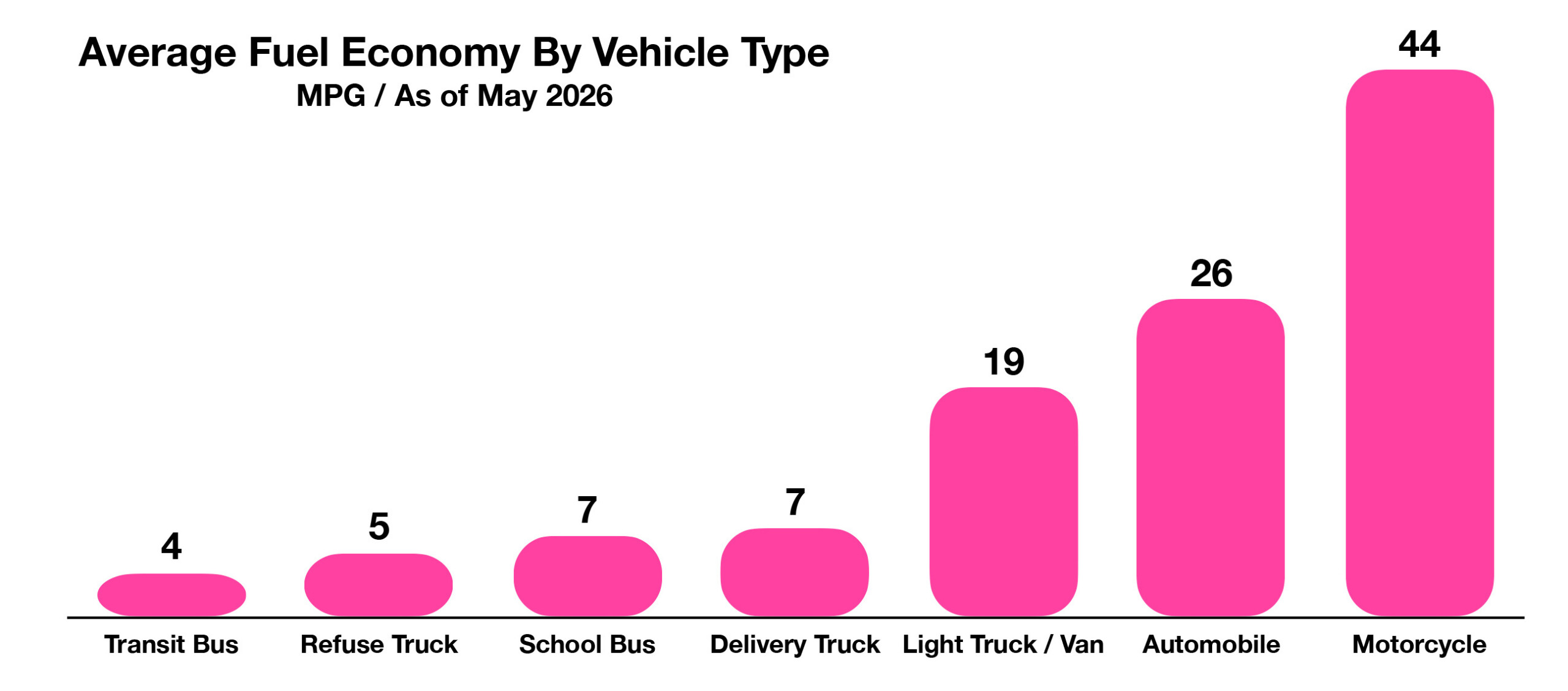
Average Fuel Economy By Vehicle – Auto Industry Overview

Advances in automotive technology have made vehicles more efficient while improving performance. Over the past several decades, automakers have increased horsepower while reducing fuel consumption. Today’s smaller four-cylinder engines can generate power comparable to that of many V8 engines from the 1970s and 1980s, which were often criticized for poor fuel economy. Data from the U.S. Energy Information Administration dating back to 1949 show a long-term improvement in vehicle fuel efficiency. The average vehicle achieved roughly 13 miles per gallon in 1949, compared with 18.4 miles per gallon in the most recent data. The proliferation of electric vehicles has prompted automakers to develop more efficient gasoline engines to remain competitive. However, some consumers have been more hesitant to adopt EVs because of charging times and infrastructure limitations. Fuel economy varies widely across vehicle types and between public- and private-sector fleets. In recent years, municipal and federal agencies have increasingly adopted more fuel-efficient vehicles than those commonly used in the private sector. (Source: U.S. EIA)