Aspen Wealth Management, Inc.
9300 W. 110th Street, Suite 680
Overland Park, KS 66210
913.491.0500
| Dow Jones | 50,906 |
| S&P 500 | 7,651 |
| Nasdaq | 26,861 |
| 2 Yr Treasury | 4.88% |
| 10 Yr Treasury | 5.29% |
| 10 Yr Municipal | 4.13% |
| High Yield | 8.16% |
| Dow Jones | 5.91% |
| S&P 500 | 11.77% |
| Nasdaq | 15.57% |
| MSCI-EAFE | 8.05% |
| MSCI-Europe | 3.83% |
| MSCI-Far East | 19.22% |
| MSCI-Emg Mkt | 21.40% |
| US Agg Bond | -2.91% |
| US Corp Bond | -3.11% |
| US Gov’t Bond | -2.85% |
| Gold | 4,189 |
| Silver | 60.75 |
| Oil (WTI) | 90.34 |
| Dollar / Euro | 1.13 |
| Dollar / Pound | 1.32 |
| Yen / Dollar | 157.37 |
| Canadian /Dollar | 0.70 |
Macro Overview
Energy and Geopolitics
Middle East crude exports rebounded in September to their highest level since the war began in February. By quarter-end, shipments through the Strait of Hormuz and alternative bypass routes had recovered to just under 80% of prewar regional flows. OPEC’s largest producer, however, continues to struggle: Saudi Arabia’s crude output plunged to its lowest level since 1990, as renewed hostilities between the U.S. and Iran disrupted the kingdom’s export routes and production.
Rates and Bonds
Government bond yields are rising worldwide. The 10-year Japanese government bond yield breached 3% in September, its highest level since 1996, and yields also climbed in the United States, Germany, France, Italy, the U.K., South Korea, and Australia. At home, a growing number of fixed income analysts warn that the Federal Reserve’s continued rate increases to fight inflation could tip the economy into recession. Higher borrowing costs on mortgages, auto loans, credit cards, and personal loans are already prompting consumers to rethink future spending.
Equities
Because a Fed rate hike is widely anticipated, analysts don’t expect equities to sell off when it arrives and say markets could even rally on the news. Investors remain focused on the revenue and margin growth driven by AI rather than on an already priced-in rate increase. A growing number of equity analysts also expect strong fourth-quarter 2026 earnings to lift stock indices heading into 2027.
The Economy and the Consumer
Despite higher energy costs and supply chain disruptions from the conflict with Iran, recent data show that sustained consumer and business demand is holding up, and this kind of domestic activity tends to cushion the economy from overseas political rifts. Sentiment tells a gloomier story: the University of Michigan Consumer Sentiment Index fell to 48.1 in September, a four-month low, amid growing worries about prices and growth, and respondents’ outlook for the year ahead dropped to its lowest level since 2022.
Other Developments
Three of the most influential figures in artificial intelligence have issued a warning about how AI’s advancement could affect humanity, and the development of superhuman machine intelligence (SMI) has become a central concern for some scientists and engineers. Separately, more than 34,600 people died from heat across five Western European countries this summer, as the region recorded its hottest June, July, and August on record.
Sources: Federal Reserve, Treasury Dept., Univ. of Michigan, OPEC, Bloomberg
Equities Endure Volatility – Domestic Stock Market Update
Volatility jolted equities in the third quarter, as uncertainty surrounding the conflict with Iran and rising rate jitters drove stock prices in varying directions. Earnings have become a focal point in the fourth quarter, as analysts estimate that the S&P 500 index will have favorable earnings reported for the 4th quarter heading into 2027. Technology and communications sector stocks led the S&P 500 index in September, while all other nine sectors were negative. Some analysts believe that such a disparity is indicative of an AI-driven stock index, meaning that AI-related companies are accounting for the majority of S&P 500 gains so far this year. Semiconductor stocks currently account for roughly 60% of the average daily activity for the S&P 500 index, divulging the extent of the run-up in the sector over the past year and a half. Such exposure could exert undue volatility to the broad index should a pullback in the sector occur.
Currently, the total U.S. stock markets’ value of approximately $78 trillion is 230% of U.S. GDP, which is roughly $32 trillion. The current ratio is nearly double of what it was in 2000, before the dot-com fallout. This gauge also known as the (Warren) Buffett Ratio is followed by analysts and investors alike, but only for a long-term perspective on company and market valuations. (Sources: S&P, Bloomberg)
Fed Leans Towards More Hikes – Fixed Income Overview
Treasury Secretary Scott Bessent attempted to curtail falling Treasury bond prices in September by buying $6 billion in long-term Treasury bonds. Markets were expecting a more sizable buyback and reacted with a lackluster reception. Short-term yields elevated approaching long-term yields in the third quarter as the Fed communicated its intention to raise short-term rates in order to combat inflation. The Treasury yield curve has been flattening since the beginning of the conflict with Iran. A flattening yield curve for Treasuries can also be indicative of a slowing economic environment and tightening availability of credit. U.S. mortgage rates rose to the highest level in more than two years, weighing on a housing market which has been suppressed by inflated prices and sluggish sales. The average 30-year fixed mortgage rose to 7.12% in mid-September, from 6.06% at the beginning of the year. (Sources: Freddie Mac, U.S. Treasury)
Wages Are Not Keeping Up With Inflation – Labor Market Update
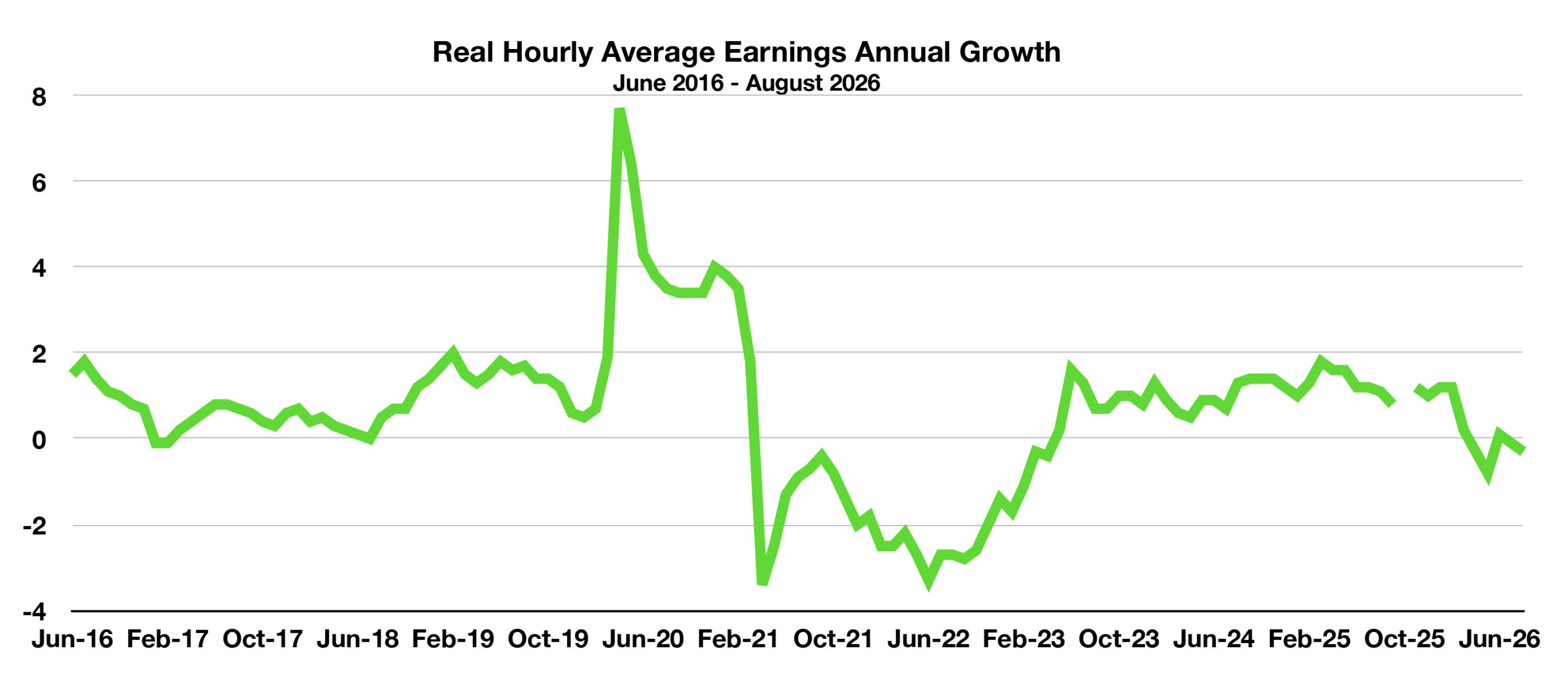
For the past five months, prices have been rising faster than wages, a dynamic that might have pushed consumers to scale back. Instead, consumers have kept spending regardless of rising prices and lingering wage growth.
Consumers Aren’t Feeling It – Consumer Behavior
A Federal Reserve study titled “Tracking Consumer Sentiment Versus How Consumers Are Doing Based on Verified Retail Purchases”, suggests that consumers don’t want to give up their lifestyles regardless of rising prices and lower wages. A gauge of the outlook for the economy slumped in September to the lowest level since 2022. Consumer expectations for personal finances also deteriorated as rates rose and wages stagnated.
Inflationary expectations took a turn in September, as the University of Michigan Consumer Sentiment Index revealed that consumers actually bought more larger ticket items in September, such as cars and appliances. Many economists believe that this occurs when consumers expect prices to keep rising in the near future. The Fed looks for dynamics such as this in order to justify rate increases that eventually put a damper on rising prices. If consumers have to pay a higher interest rate to purchase a car or a washing machine on credit, then the additional cost to borrow will eventually dissuade consumers from making such a purchase.
Since the start of the year, consumer sentiment has declined for all groups by age, education, geography, political party and income, according to the Fed report. Ironically, buying conditions for durable goods have temporarily improved due to a perception that completing such purchases now would help consumers avoid higher prices in the future. (Sources: Federal Reserve, University of Michigan)
Home Price Cuts On The Rise – Housing Market Update
Approximately one in five homes for sale had a price cut in August, the highest amount for any August since 2020 according to Freddie Mac data, while 45% of August sales involved a seller concession. The typical home spent 50 days on the market, up from 36 days when rates were approaching 8% nearly three years ago. With 1.5 million homes for sale, up 46% from 2023, buyers have ample room to negotiate.
Various factors affect home prices, including supply of homes, economy, labor market, demographics and interest rates. Insurance coverage is becoming more of a growing factor as coastal areas and wildfire-prone areas are seeing heightened premiums and random policy cancellations. With the average selling price of a home nationally at over $500,000, mortgage loan interest becomes much more of an obstacle for buyers.
Sellers have begun to slash asking prices on their homes across the country, resulting in lower sales prices for homes. The average price of a home sold has fallen from $541,000 over the past year to $500,000, representing roughly a 7.5% drop. As asking prices decline, buyers have the upper hand, allowing for stronger negotiation and lower loan payments. (Sources: Freddie Mac)
U.S. Refineries Running At Nearly Full Capacity- Domestic Oil Industry
With passage through the Strait of Hormuz still uncertain, global oil supplies and prices remain severely disrupted. As Middle East supplies have dwindled, many countries have turned to the United States to make up the shortfall. U.S. crude exports hit a record 5.6 million barrels per day in April, and exports of crude and refined products combined set an all-time high of 13.6 million barrels per day.
Advances in drilling and hydraulic fracturing have driven steady increases in domestic production, which now stands near 14 million barrels per day, up from about 7.4 million in 1990. Refining capacity, however, hasn’t kept pace. No major new refinery has been built in the U.S. since 1977, and the number of operating refineries has fallen from about 205 in 1990 to 130 today. Although the remaining plants have expanded, total refining capacity dipped about 1% last year after closures in Houston and Los Angeles. Many U.S. refineries are also designed to process heavier crude than the light shale oil now produced domestically, so a large share of new production is exported rather than refined at home. The result is a bottleneck: refineries are running near their limits even as global demand for fuel surges, which keeps refining margins and gasoline prices elevated.
(Sources: Library of Congress, U.S. Dept. of Energy)
How IRMAA Affects Your Medicare Premium
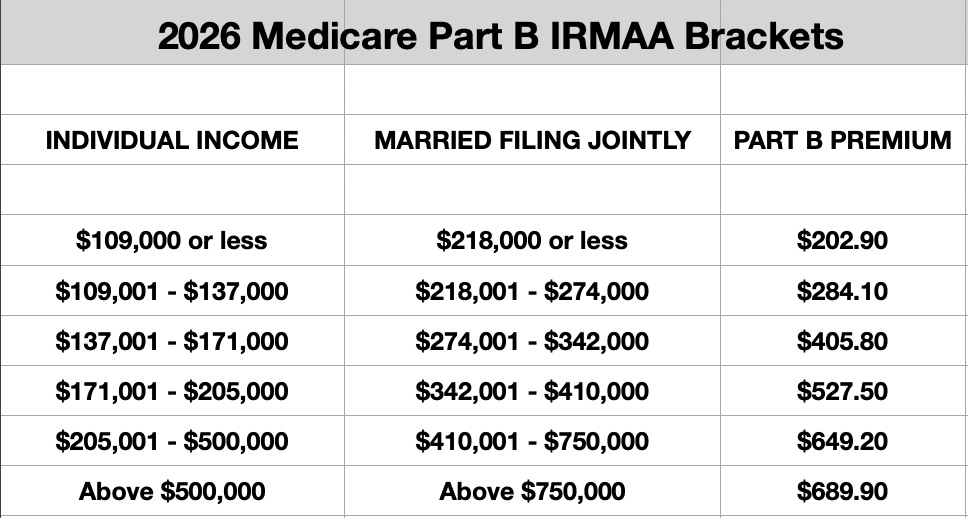
Higher-income retirees may pay more for Medicare than they expect, so it’s worth knowing the income thresholds each year. The Income-Related Monthly Adjustment Amount (IRMAA) is a surcharge added to the standard monthly premium for Medicare Part B and Part D for beneficiaries whose income exceeds certain limits. For 2026, the standard Part B premium is $202.90 a month. IRMAA applies to individuals with income above $109,000 and to married couples filing jointly with income above $218,000, raising Part B premiums to between $284.10 and $689.90 a month and adding $14.50 to $91 a month to Part D premiums.
IRMAA is based on your modified adjusted gross income (MAGI) from the federal tax return filed two years earlier, so your 2026 premium is based on your 2024 return. For IRMAA purposes, MAGI is your adjusted gross income plus any tax-exempt interest. Because the brackets act as cliffs, even $1 over a threshold triggers the higher surcharge for the full year. A one-time event such as a large capital gain, a Roth conversion, or a sizable IRA withdrawal can push you into a higher bracket.
If your income has dropped because of a qualifying life-changing event, such as retirement, a reduction in work hours, marriage, divorce, or the death of a spouse, you can ask Social Security to recalculate your IRMAA using more recent income by filing Form SSA-44.
(Sources: Social Security Administration; Centers for Medicare & Medicaid Services)