
Robert Krueger
Auburn Skies Financial Advisors LLC
3504 Lillard Court
Fairfax, VA, 22033
703.734.3308
| Dow Jones | 52,319 |
| S&P 500 | 7,499 |
| Nasdaq | 26,213 |
| 2 Yr Treasury | 4.14% |
| 10 Yr Treasury | 4.44% |
| 10 Yr Municipal | 2.89% |
| High Yield | 6.99% |
| Dow Jones | 8.85% |
| S&P 500 | 9.55% |
| Nasdaq | 12.79% |
| MSCI-EAFE | 7.74% |
| MSCI-Europe | 5.92% |
| MSCI-Far East | 12.84% |
| MSCI-Emg Mkt | 22.68% |
| US Agg Bond | 0.61% |
| US Corp Bond | 0.85% |
| US Gov’t Bond | 0.49% |
| Gold | 4,010 |
| Silver | 58.85 |
| Oil (WTI) | 70.08 |
| Dollar / Euro | 1.14 |
| Dollar / Pound | 1.32 |
| Yen / Dollar | 161.86 |
| Canadian /Dollar | 0.70 |
Macro Overview
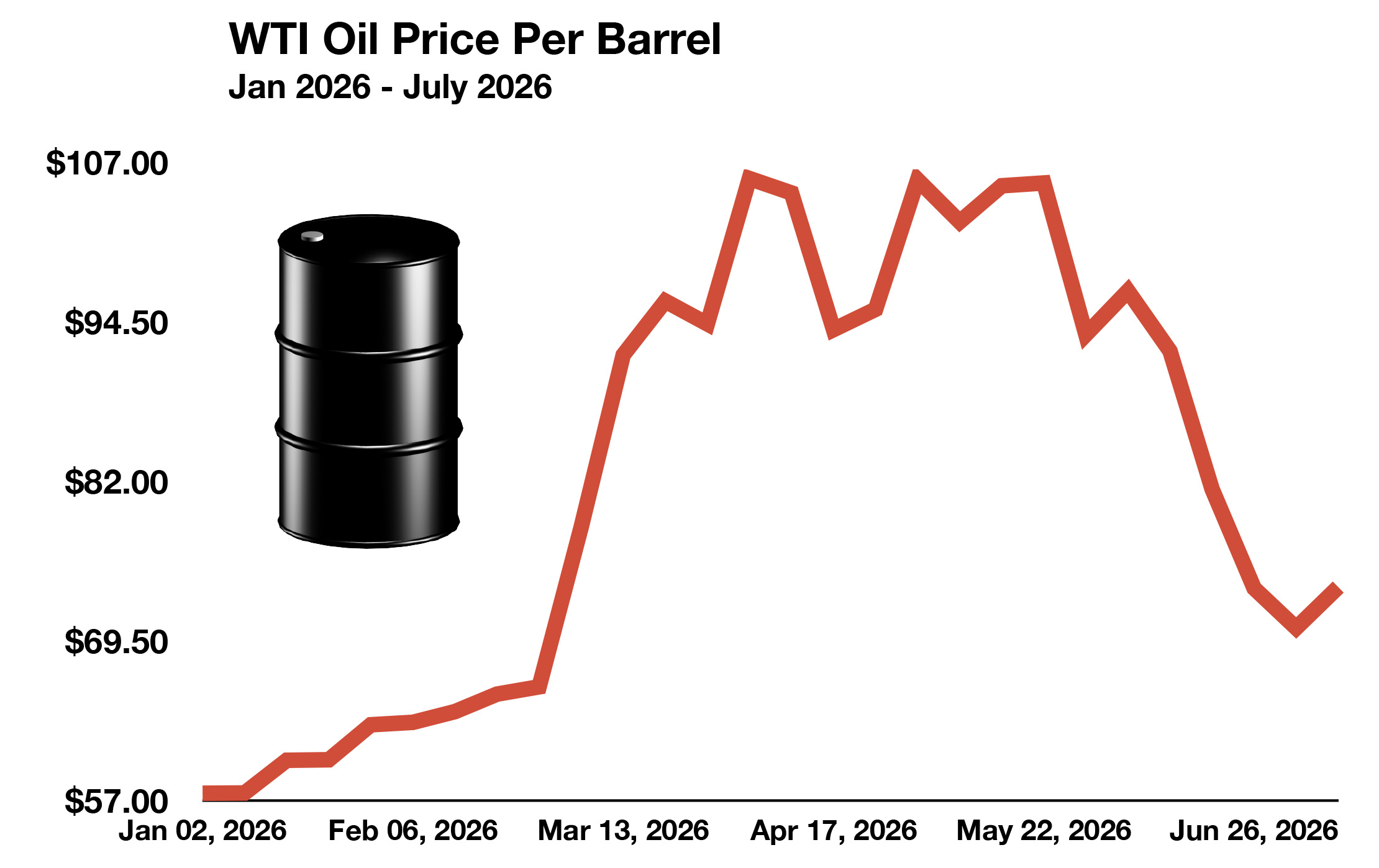
Resurfacing hostilities between Iran and the U.S. heightened tensions and rattled markets during the early days of July. A faltering peace agreement between the U.S. and Iran has become a critical indicator of where oil and energy prices might be headed. Crude oil prices saw the largest quarterly drop since 2020 following the announcement of the initial peace accord, with West Texas Intermediate (WTI) falling to $69.50 per barrel in June from $112.95 in April. Iran is struggling to sell its oil and regain market share lost during the conflict. Iran’s largest customer, China, is now buying cheaper oil from the United Arab Emirates (UAE) and Iraq, dealing a blow to Iran. The opening of the Strait of Hormuz has boosted supply and is allowing the flow of oil deliveries to distant buyers globally.
Concurrently, Iran is contending that it has the right to control shipping traffic through the Strait of Hormuz, placing the peace agreement at risk as the ceasefire becomes increasingly difficult to maintain. The idea behind the relaxation of imposed sanctions on Iran would allow Iran to sell its oil globally in U.S. dollars, thus dissolving a black market for its oil which was almost entirely being sold to China illegally. Approximately 80% of all oil traded worldwide is traded in U.S. dollars. The Japanese yen traded at its lowest levels since 1986, as the Japanese government continued deliberations over whether to raise interest rates in order to curtail a further slide. The weakening yen is triggering inflation and higher import prices for Japanese consumers. Gold fell slightly in June as the metal traded 30% off its highs reached in January. Traded as a hedge against inflation and used to offset currency valuations, gold can be an indicator of sentiment and economic expectations. Dissipating inflationary worries also helped push gold prices lower in June. The expansion of data center construction is creating concerns among homeowners in certain parts of the country as the demand for electricity climbs due to insatiable demand from data centers. Several economists and analysts believe that falling oil prices along with a slowing labor market might eventually lead the Fed to consider a rate reduction. Stubbornly high fuel prices and an expanding labor market over the past few months gave Fed officials no reason to reduce rates, until now.
Renewed concerns surrounding China emerged following the launch of a long-range ballistic missile from a nuclear submarine in the Pacific Ocean. The rare missile test is a concern as China exhibits its military prowess and ability to reach distant targets. Recently enacted legislation now allows for the establishment of Trump Accounts, which are tax-deferred investment accounts for U.S. children under 18. The accounts were officially launched on July 4, 2026, and children born between 2025 and 2028 will receive an initial $1,000 deposit from the U.S. government, which may then be invested for future growth. Continued volatility in oil prices disrupts market stability and makes expense projections more difficult for companies. West Texas Intermediate (WTI) nearly doubled following the beginning of the Iranian conflict, then fell more than 35% in response to the peace agreement drafted in June. Reignited hostilities then drove prices higher in the early days of July, leaving energy markets on edge.
Sources: IEA, Fed, U.S. Treasury, trumpacccounts.gov
Fed Officials Mixed on Rate Direction – Fixed Income Overview
Numerous analysts expected that a successful resolution to the conflict with Iran would help bring about a lower rate environment, leading to lower mortgage rates and consumer loan rates. U.S. Treasury yields slightly fell in June as inflationary concerns eased and certain Fed members signaled that rate increases were not a certainty at this point. Markets are concerned that a return to hostilities with Iran may hinder a lower rate trajectory. Fed officials are increasingly mixed surrounding the direction of rates and how to interpret the effects of the Iranian conflict and the labor market. Growing uncertainty has several Fed members “on the fence” as to what direction the macro environment may take. Regardless of the current elevated interest rate environment, mortgage rates are still below their 55-year average of 7.68% for a 30-year fixed conforming loan, with a rate of 6.49% at the end of June.
Sources: Treasury Dept., FreddieMac, Federal Reserve
Equities Veer as Uncertainty Looms – Domestic Equity Overview
Major equity indices advanced in June as a peace accord fueled stocks. Leading sectors for the month included healthcare, biotechnology, pharmaceutical, and homebuilders driven by better-than-expected earnings and growth. The prospect of lower oil prices stoked optimism for stocks with the anticipation of lessening inflationary pressures and lower transportation costs. Lower fuel prices are expected to minimize the burden of costly fuel, eventually translating into improved profit margins. A rotation from technology and high-growth sectors to large-cap value and lower beta sectors emerged in the second quarter. Analysts are following a growing divergence among sector performance so far this year, which might indicate a fundamental change in the equity markets.
Sources: Dow Jones, S&P, Bloomberg, Reuters
Consumers Saving Less & Spending More on Fuel & Utilities – Consumer Expenditures
Consumers have seen a significant increase in their fuel and housing expenses, hindering their ability to spend elsewhere. Gasoline and fuel costs soared over 28% from April to May, along with housing and utilities rising over 22% for the same period. Consumers are saving less as they try to keep up with rising costs, with the personal savings rate dropping in April to 2.6%, a dramatic drop from 6.4% at the beginning of 2024. As expenses have risen, consumers rely more on savings to help supplement their monthly costs. Some consumers are starting to experience some financial distress by tapping their credit cards and lines of credit in order to meet monthly expenses.
Sources: BLS, Federal Reserve Bank of St. Louis
Volatile Oil Prices Create Uncertainty- Energy Sector Overview
With oil falling nearly 40% from its highs in April as a result from the contentious cease fire with Iran in June, an expectation has arisen that gasoline prices will soon fall as well. An ensuing drop in gasoline and diesel prices would alleviate inflationary pressures, thus giving consumers a much needed break. Some analysts believe that if this should occur, the Fed’s stance on inflation might very well change course, perhaps in the direction of even a rate reduction towards the end of the year. Fuel consumption makes up roughly 8% of the Consumer Price Index (CPI), which measures the rate of inflation for U.S. consumers. Lower diesel and gasolines prices also affect the price of goods and products, such as food and merchandise, which are transported nationally by rail and truck.
Sources: EIA, BLS, Dept. of Labor, Dept. of Transportation

New Rules Surrounding 401k Catch Up Contributions in 2026 – Retirement Planning
At mid-year, it is wise to review retirement plan contributions and any imposed limits in order to plan accordingly. Effective this year, if you’re age 50 or older and had $150,000 or more in prior-year FICA wages from an employer-sponsored plan, your 401(k) catch-up contributions must be made as Roth contributions starting in 2026. If you earned less than that, you could generally keep making catch-up contributions pre-tax or Roth, depending on your company plan’s options. The catch-up contribution limit for 2026 is $8,000 for employees age 50 and older, and the total 401(k) employee deferral limit is $24,500. For ages 60 to 63, there is an enhanced catch-up limit of $11,250 if the company plan allows it. The Roth-only catch-up rule applies to the catch-up portion only, not regular salary deferrals. It is based on the prior year’s wages from that same employer, and if the company plan does not offer a Roth 401(k) option, employees may not be able to make catch-up contributions under the rule.
Source: IRS.gov
How 529s Can Be Converted to Roth IRAs – Financial Planning
When 529 College Savings plans became effective 30 years ago, rules and restrictions limited the use of the funds strictly for college-related expenses. Over the years, updated legislation has alleviated some of these restrictions as well as allowed unused funds to be utilized as a retirement savings vehicle. In order to qualify to have 529 funds converted to Roth IRAs, the 529 plan must have been open for at least 15 years before a rollover is allowed. If you change the beneficiary, the clock may reset, potentially affecting eligibility. Only funds in the 529 that have been in the account for at least 5 years are eligible for transfer. Contributions and earnings from the most recent 5 years cannot be rolled over. Each rollover is limited by the Roth IRA annual contribution limit for the year ($7,500 for individuals under age 50 for 2026) of the transfer and the amount cannot exceed what you could contribute to a Roth IRA in that year. There is also a lifetime rollover limit of $35,000 per beneficiary. The Roth IRA must be owned by the same beneficiary as the 529 plan, so the 529 beneficiary must be the Roth IRA owner for the rollover to occur. The beneficiary must have earned income at least equal to the amount being rolled over. There are no income limits on who can rollover funds from a 529 to a Roth IRA. Using a direct trustee-to-trustee transfer from the 529 plan to the Roth IRA avoids taxes and penalties, versus taking money out first as a withdrawal, which could create a taxable event or penalties.
Source: IRS, Section 529 IRS Publication.
Trump Accounts / Effective July 4th – Financial Planning for Children
Trump Accounts are a newly introduced federal investment program designed to help children begin building wealth from an early age. Trump Accounts became eligible to accept initial contributions on July 4, 2026. These accounts are expected to provide eligible children born between January 1, 2025, and December 31, 2028, with a one-time $1,000 government contribution, which can remain invested alongside future contributions from parents, family members, employers, and other eligible sources. The intention behind the accounts is to help encourage long-term investing, by giving children early exposure to U.S. stock market investments tracking a qualified index, such as the S&P 500 Index. The concept is that an early start gives investments more time to grow, with even small contributions potentially increasing in value over decades via the dynamics of compound growth and tax-deferred accumulation. Under current legislation, the accounts are structured similarly to traditional individual retirement accounts (IRAs), with a parent or guardian serving as custodian until the child reaches the age of 18. After age 18, many of the withdrawal restrictions no longer apply and the account generally operates similarly to a traditional IRA. Parents, family members, employers, charities, and other eligible contributors may contribute up to $5,000 annually per child. Account assets are limited to certain low-cost index funds tracking the U.S. stock market. Withdrawals are restricted until the child reaches the age of 18.
Sources: U.S. Government, https://trumpaccounts.go