We believe solid earnings growth, low oil prices and a weaker dollar were the primary drivers of markets in the second quarter. Stocks around the world are benefiting from a backdrop of stable growth and falling inflation.
The resounding victory by President Macron in France and the poor showing by the Conservatives in the UK turned the tide against the forces of isolation in Europe. European markets and the Euro responded positively and began to unlock the value we believe exists there.
In the US, President Trump’s political agenda has been stymied by Republicans’ failure to agree on healthcare reform. Tax reform will have the biggest impact on risk assets and a stock market correction could be triggered if progress on tax reform is pushed out into 2018.
Commodity prices fell, led by oil as US production continues to ramp up, driven by ever improving technological advances, even as OPEC tried to maintain production cuts. This provided a benign inflation backdrop.
10-year Treasury Note yields were little changed even as the Federal Reserve raised interest rates by a further 0.25%. The yield ended the quarter at 2.3%.
Remain Overweight to Equities and Added to Emerging Markets
Our tactical and strategic portfolios are positioned to reflect our belief that stocks will outperform bonds this year, but that the best returns will come from the international markets. Our momentum indicators support our overweight position as the primary trends for most major stock markets are up.
Our preference for non-US stocks increased during Q2. The relative value case has been apparent to us for several years, but relative momentum has been lacking until this year. We added to emerging markets early in the quarter, and expect the recent trend of positive relative price and economic momentum to continue.
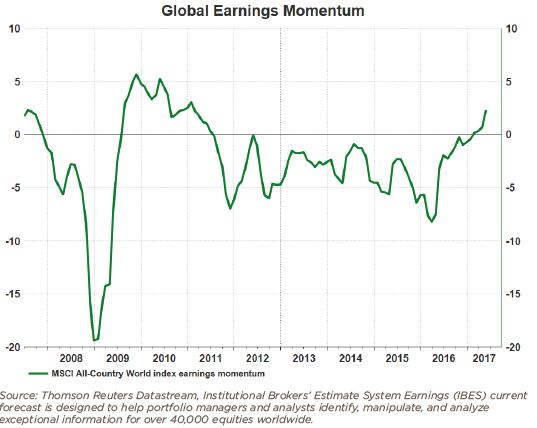
We are seeing global earnings momentum improve to its strongest level since 2010, with a particular emphasis on areas like the Eurozone, Japan and emerging markets. We view this as positive for global stock markets.
Outlook For The Second Half of 2017
We believe the current bull market in equities could be extended because the inflationary pressures and tightening monetary policy that typically bring a bull market to an end may be deferred for longer than has historically been the case. Global interest rates could remain near current record lows. Both the European Central Bank and Bank of Japan have pledged to continue Quantitative Easing policies until inflation rises to their targeted levels.
The Fed is unlikely to push short rates above the rate of inflation (about 1.5% to 2.0%) if disinflationary forces remain in place. We think bond market returns will be disappointing given low starting yields and tight credit spreads.
We believe technology and production efficiencies will likely keep most commodity prices under pressure.As a result, the energy sector could suffer deflationary pressures that OPEC may not be able to contain. The dollar is likely to be range bound, in our view, with higher relative interest rates in the US offset by improved growth and investment prospects in the Eurozone, Japan and select emerging markets.
Biggest Risks That Could Trigger a Major Market Correction
Aggressive Fed Action – The Fed actually believes they can start a balance sheet unwind, yet it will have little to no impact on bond and equity prices. It is hard to rationalize why the Fed started QE in the first place, if it did not believe stock and bond prices would be affected, but then when the process is reversed, to expect bond and stock prices not to move doesn’t make sense. Starting at a rate of $10 billion per month, unwinding Treasuries and mortgage backs, a scale up in selling could bring the amount of selling to $200 billion over one year, an amount not far from the total U.S. budget deficit. Why should the Fed do this, unless the Fed is targeting financial market prices?
Geopolitical Risks –
North Korea – Shamrock’s market strategist believes that Kim Jong-un may be further along the path to developing an ICBM that can reach the U.S. than had been expected. In fact, the North Koreans may have advanced to the point a military solution to the problem has become almost unthinkable. The casualty rates alone would stop most decision makers. So whatever deal was in the works, whether it was China/Russia pushing to make the Korean peninsula one entity which the U.S. rejected or the other way round with the U.S.-China trying to essentially buyout the North Korean regime, so far nothing has worked. President Trump is right, time is running out.
Middle East – Shamrock’s market strategist believes an agreement to resolve the Qatar situation is underway, but the solution really lies with Saudi Arabia. The root of the entire issue is Saudi’s low price oil strategy. Change that and everything improves, for the Mideast economies. So changing the people who promoted that strategy is probably the most visible thing that can be done to pop the oil price back into the mid-50s.
Brexit – UK Prime Minister Theresa May’s decision to hold snap elections to strengthen the Conservative majority backfired. The Labour’s party leader wants to raise the top marginal tax rate to 90%. If the Labour party gains control of Parliament, there will be an exit of private capital from the UK. That would be in addition to jobs which are already leaving the city for Paris, Frankfurt, Dublin, Amsterdam, due to Brexit. Deutsche Bank, as an example, will move large parts of its trading and investment banking assets out of London to Frankfurt. JP Morgan has warned it may have to move people out of London, to the EU. Even HSBC has said it may move out of London. These types of moves represent thousands of jobs which pay well. A severe recession in the UK could derail the growth we are seeing in the Eurozone.