Fortis Wealth Management

(888) 336-7847 (3FORTIS)

www.investfortis.com

November 2025
Market Update
(all values as of 10.31.2025)

Stock Indices:

Dow Jones 47,562
S&P 500 6,840
Nasdaq 23,724

Bond Sector Yields:

2 Yr Treasury 3.60%
10 Yr Treasury 4.11%
10 Yr Municipal 2.73%
High Yield 6.53%

YTD Market Returns:

Dow Jones 11.80%
S&P 500 16.30%
Nasdaq 22.86%
MSCI-EAFE 23.69%
MSCI-Europe 25.44%
MSCI-Pacific 25.83%
MSCI-Emg Mkt 30.32%
 
US Agg Bond 6.80%
US Corp Bond 7.29%
US Gov’t Bond 6.51%

Commodity Prices:

Gold 4,013
Silver 48.25
Oil (WTI) 60.88

Currencies:

Dollar / Euro 1.15
Dollar / Pound 1.31
Yen / Dollar 153.64
Canadian /Dollar 0.71

Macro Overview

The Federal Reserve reduced the federal funds rate by a quarter point in late October but signaled uncertainty about more cuts this year. Persistent inflation concerns remain central to the Fed’s outlook, alongside signs of a softening labor market and rising layoffs across several industries.

The U.S. government shutdown, driven by a congressional stalemate, has now surpassed the previous record of 34 days set in 2019, making it the longest in history. The disruption has affected air traffic control, national parks, and federal benefit programs such as food stamps and small business loans. On Monday, November 10, the Senate approved a spending package to end the shutdown.

An increasing number of companies are reporting higher profits following the adoption of artificial intelligence and workforce reductions. Firms are investing heavily in AI infrastructure—from data centers to semiconductor chips and utilities—while layoffs mount in sectors where AI is proving most effective.

A growing chorus of analysts and economists warns that the Fed’s current pace of easing may be too little, too late, as consumer loan delinquencies continue to climb. Commercial real estate loans also remain under pressure from elevated variable rates, a lingering effect of the rapid tightening cycle in 2022 and 2023.

Japan’s new Prime Minister, Sanae Takaichi, the country’s first female leader, enjoys broad support for her ambitious fiscal and economic agenda. Japan, now the world’s fourth-largest economy after Germany, China, and the United States, remains a linchpin of global trade through its extensive manufacturing base and key partnerships with neighboring nations and the U.S.

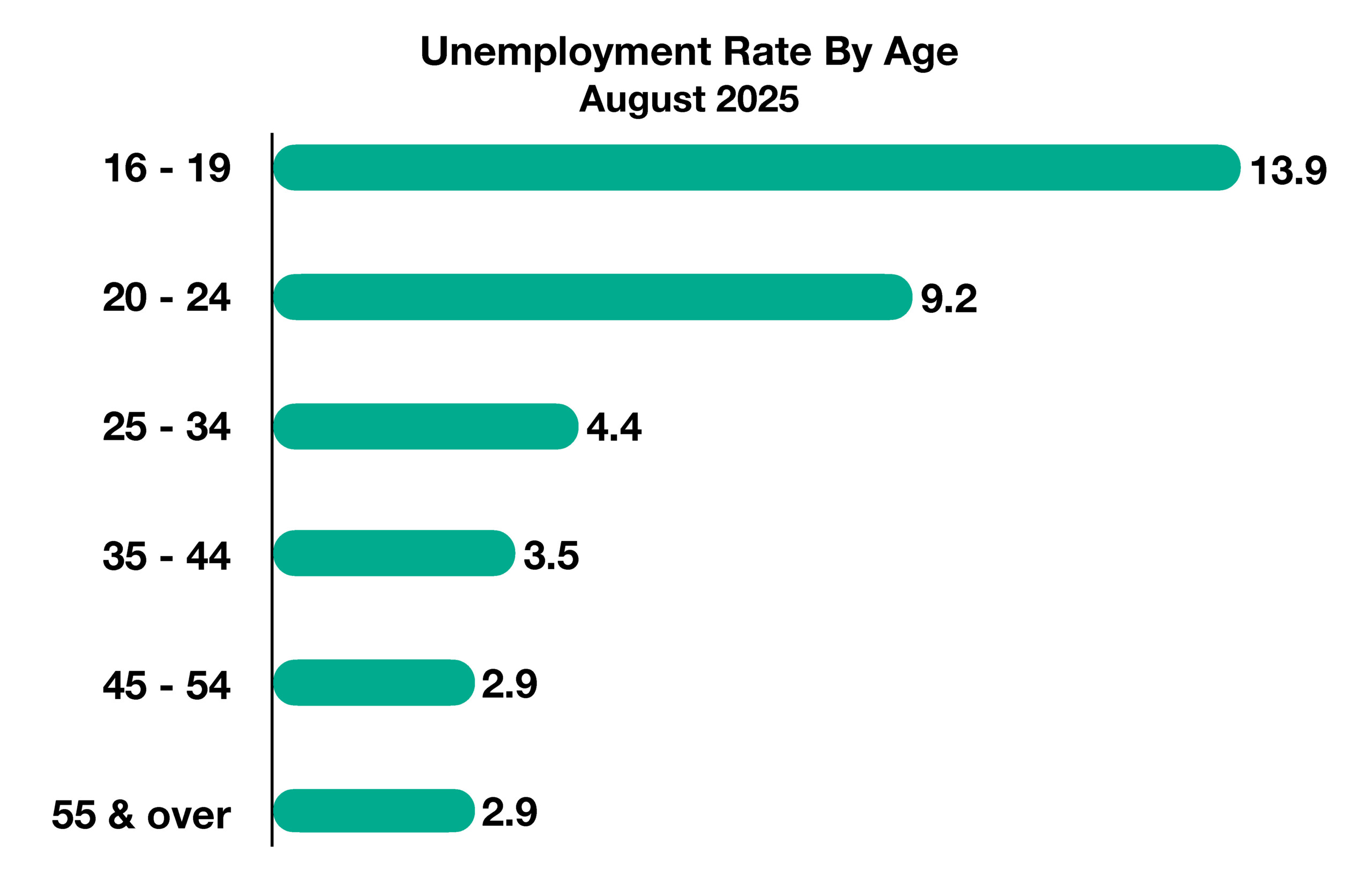
Unemployment is highest among workers aged 16 to 24—more than twice the overall jobless rate. Younger applicants are finding it increasingly difficult to secure employment as more firms initiate layoffs and scale back hiring.
Inflation rose less than expected recently, suggesting moderating price pressures could encourage the Fed to continue its rate-cutting trajectory. The central bank, however, has hinted it may pause in December if data do not justify further easing. Consumer prices increased 3% year over year as of September 2025—a sharp decline from the 9.1% peak reached in June 2022.

Sources: Dept. of Labor, Federal Reserve, Bureau of Labor Statistics, Treasury Department

 
In 1980 a 19" color television cost about $400 adjusted for inflation

Earnings & Dwindling Inflation Propel Equities in October – Domestic Equity Update

The information technology sector extended its leadership in October, maintaining the momentum that has defined markets since the start of the year. Utilities and communication services have also bolstered the S&P 500’s performance, as investors continue to favor companies tied to artificial intelligence—a dominant theme in 2025.

Analysts say the market is shifting toward a stock picker’s environment, where individual company performance matters more than broad index exposure. The outsize influence of the “Magnificent Seven”—whose gains have accounted for much of the S&P 500’s advance—underscores how select names are driving returns and may continue to outpace the broader market. So far this year, biotechnology, telecommunications, semiconductors, and aerospace stocks have led sector gains, while transportation, homebuilding, and regional banking have trailed, reflecting a more uneven economic landscape beneath the headline indexes. (Sources: S&P, Dow Jones, Nasdaq, Bloomberg)

Bond Market Hesitant About Economic Data – Fixed Income Overview

The Federal Reserve announced it would stop selling its inventory of Treasury bonds, a process it has used since 2022 when it began raising interest rates. The reduction in the supply of Treasuries entering the market is expected to help lower bond yields, as reduced supply tends to push prices higher. The Fed has been passively shrinking its $6.6 trillion asset portfolio since mid-2022, when holdings peaked at nearly $9 trillion as part of its extraordinary efforts to support financial markets and the economy.

The reliability of inflation and employment data has become a challenge for the Federal Reserve’s policy objectives, prompting officials to rely increasingly on private-sector research in addition to their own reports, such as the Beige Book. (Sources: Treasury Dept., Federal Reserve)

Why A TV Only Costs $6 Today – Technological Advancement

The average cost of a standard television in the United States, adjusted for inflation, has fallen sharply over the past 50 years. A TV that cost $1,000 in 1950 would cost roughly $6.19 in 2025 for an equivalent product.

Advances in technology have driven television prices sharply lower in recent decades, as resistors, semiconductors, and display panels have become lighter, more efficient, and cheaper to produce. Televisions are among the few products to experience steep price deflation compared with overall inflation trends.

In 1980, a typical 19-inch color TV cost about $400 in today’s dollars. That same amount now buys a much larger 65-inch model with smart technology that didn’t exist 45 years ago. Innovation has likewise reduced costs across many products—especially in electronics, energy, and software—making them more affordable and accessible to millions of consumers. (Sources: Federal Reserve Bank of St. Louis, BLS)

 
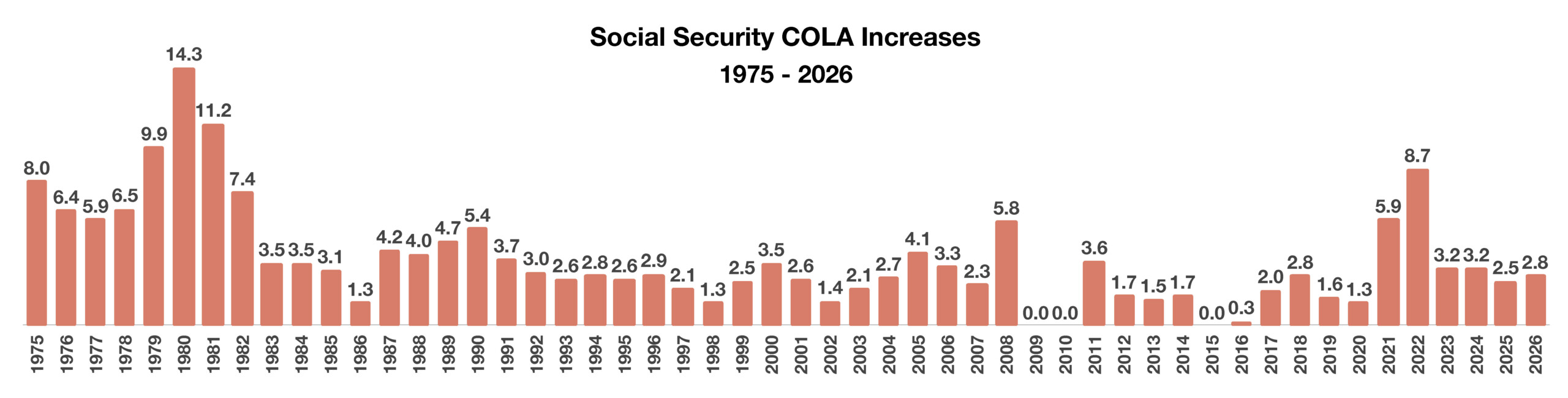
Social Security recipients will get an increase of 2.8% in 2026

Social Security COLA Increase of 2.8% Lags Medicare Premium Increase in 2026 – Retirement Planning

Social Security recipients are set to receive a 2.8% increase in 2026, a modest uptick from the cost-of-living adjustment (COLA) in 2025. For many beneficiaries, the higher payments will largely offset rising living expenses and increased Medicare premiums. The benefit hike takes effect in late December 2025 for Supplemental Security Income (SSI) recipients and in January 2026 for those receiving Social Security.

Many retirees worry that the increase will fall short of covering costs rising at a faster pace—particularly essentials such as food, energy, and out-of-pocket medical expenses not covered by Medicare. Premiums for Medicare Part B are projected to climb 11.6% at the start of 2026, more than four times the size of the COLA increase.


Social Security was established on August 14, 1935, when President Franklin D. Roosevelt signed the Social Security Act into law. Since then, the program has provided millions of Americans with benefits that automatically adjust for inflation through the COLA, which has been in place since 1975. The size of those annual increases has varied over time in line with changes in the inflation rate. (Source: Social Security Administration)

It’s The Wealth Effect That Keeps Everyone Spending – Consumer Economics

A key risk to the economy now is that much of the nation’s consumer spending is being driven by top earners benefiting from the wealth effect. If the stock market were to retreat or housing prices decline, that momentum could fade quickly. Despite persistent inflation and higher interest rates, consumers have remained surprisingly resilient. Economists attribute this confidence and persistence largely to the wealth effect—the tendency for people to spend more when they feel wealthier due to rising asset values.

The rise in the wealth effect has been fueled by gains in real estate and equity markets, which have boosted household net worth by an estimated $10.3 trillion over the past year. That surge has encouraged consumers to spend more out of current income. Some analysts draw parallels to the late 1990s, when similar patterns emerged. Economists view the wealth effect as a psychological response in which higher home and stock values are treated as if they were increases in income. In reality, such asset gains may prove unsustainable and could reverse, eroding consumer confidence and spending power if valuations decline.

Source: Federal Reserve Bank of St. Louis

 
tax on crypto could raise $28 billion over the next ten years

Fed’s Beige Book Report Sheds Light On Direction of Economy – Domestic Economy

As questions grow over the reliability of labor market data collected by the Department of Labor, the search for more dependable sources has become increasingly important. Staffing cuts tied to the government shutdown have further delayed data collection and reporting. In response, many analysts and economists have shifted their focus to the Federal Reserve’s Beige Book, which compiles labor and economic data from the 12 regional Fed banks and is released every six to eight weeks.

In its most recent release last month, the Beige Book pointed to sluggish economic and labor conditions nationwide. Three districts reported modest growth, five saw no change, and four indicated slight declines. The report noted that a weakening labor market is putting pressure on consumers, with discretionary spending down from earlier periods. Employers across several industries have been reducing headcount through layoffs and attrition.

Some companies interviewed by the Fed reported increasing difficulty filling positions traditionally held by immigrant workers amid heightened immigration tensions. Several Fed districts also observed that tariff-related costs were affecting businesses, though the extent of the impact on final consumer prices remains uncertain. (Sources: Board of Governors of the Federal Reserve System, www.federalreserve.gov/monetarypolicy/publications/beige-book-default.html)

Year-End Tax Planning For Cryptocurrency Transactions – Tax Planning

As millions of investors ventured into cryptocurrency over the past year, the IRS has stepped up its monitoring of transactions to ensure that gains are properly taxed. Recently enacted tax legislation includes new provisions for identifying and taxing profits from digital currency trading. The rapid rise of cryptocurrency has created uncertainty over whether such transactions should be treated as taxable assets—similar to stocks—or as currency exchanges. Some trading platforms also pay interest on leveraged digital positions, creating additional tax liabilities on the income earned.

Recognizing a major source of potential revenue, the federal government expects to collect roughly $28 billion over the next decade through enhanced crypto tax enforcement. The IRS has begun issuing detailed guidance on how these transactions will be taxed. Digital wallets that store cryptocurrencies may soon be required to report holdings and activity to the IRS, similar to traditional financial institutions. The agency also plans to pursue taxpayers who fail to disclose gains, a point reinforced by new language on the latest tax forms.

Several cryptocurrency exchanges are preparing to issue Form 1099-MISC and 1099-K statements to comply with the new reporting standards. As digital currencies gain wider use in everyday payments, each transaction could trigger a taxable event. Spending cryptocurrency stored in a digital wallet may generate a taxable gain if the value of the asset has appreciated since purchase. The IRS is expected to require wallet providers to maintain cost-basis records for all transactions. If a platform does not issue a 1099 form, taxpayers are advised to keep detailed records of every purchase and sale to accurately report gains or losses. (Source: IRS)